Trump Rebukes Tucker Carlson Over Iran, Exposing a Growing Divide on the American Right
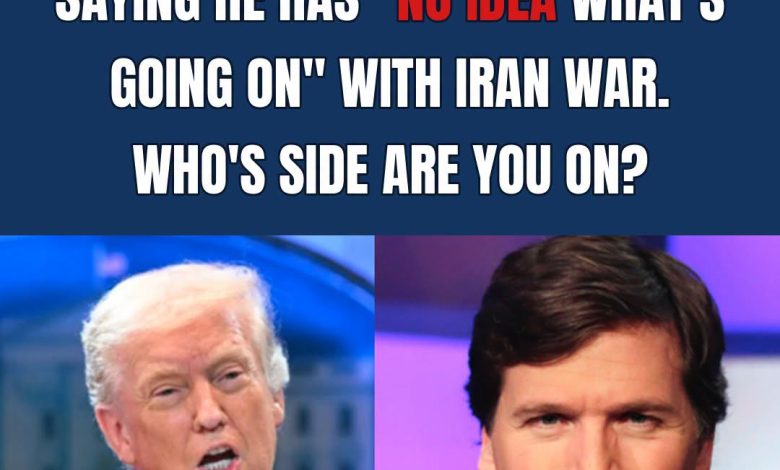
President Donald Trump has sharply criticized Tucker Carlson’s understanding of the escalating confrontation with Iran, highlighting a widening foreign-policy divide within the conservative movement.
At the center of the dispute is a fundamental question: Should the United States confront Iran through sustained economic and military pressure, or avoid deeper involvement in another Middle Eastern conflict?
Trump has consistently portrayed Iran as a direct threat to American interests. Tehran has expanded its uranium-enrichment program, supported armed groups across the Middle East and maintained close strategic relationships with Russia and China. Its network of regional partners—including Hezbollah, the Houthis and several Iraqi militias—has repeatedly threatened American troops, Israel and international shipping routes.
Carlson, however, has warned that military escalation could pull the United States into a costly and potentially disastrous war. His position reflects the increasingly influential “America First” noninterventionist wing of the Republican coalition, which argues that Washington should focus on domestic security rather than launching or supporting another open-ended conflict overseas.
Trump appears to see Carlson’s argument as dangerously detached from the realities facing U.S. military and intelligence officials.
During his presidency, Trump adopted a “maximum pressure” strategy against Tehran. His administration withdrew from the 2015 Iran nuclear agreement, restored sweeping economic sanctions and ordered the 2020 strike that killed Iranian General Qassem Soleimani, the commander of the Islamic Revolutionary Guard Corps’ Quds Force.
Trump’s supporters argue that these actions demonstrated that credible force can deter aggression without necessarily producing a full-scale war. They also point to the Abraham Accords, which normalized relations between Israel and several Arab nations, as evidence that stronger regional alliances could further isolate Iran.
Critics dispute that interpretation. They argue that Iran expanded portions of its nuclear program after the United States withdrew from the agreement and contend that military pressure can produce retaliation, miscalculation and a broader regional conflict.
That disagreement is precisely why Trump’s confrontation with Carlson matters.
This is no longer merely a personal dispute between two prominent conservative figures. It represents a larger struggle over the direction of Republican foreign policy. Traditional national-security conservatives favor deterrence, military readiness and strong support for American allies. Noninterventionists believe the foreign-policy establishment has repeatedly exaggerated threats to justify unnecessary wars.
Both sides raise legitimate concerns, but neither should oversimplify the stakes.
Diplomacy without enforcement can allow hostile governments to delay, reorganize and continue supporting regional violence. At the same time, military action without a clearly defined objective can expose American service members and taxpayers to consequences that political leaders have not fully explained.
Trump’s message is that Iran interprets weakness as an invitation to escalate. Carlson’s warning is that Washington must not confuse toughness with an obligation to enter every conflict.
For American voters, the critical questions are therefore more specific than whether a leader appears “strong” or “weak.” What is the United States trying to achieve? What actions would trigger a military response? How would escalation be contained? And what would constitute a successful outcome?
Iran’s nuclear ambitions, proxy forces and threats against American interests cannot simply be dismissed. But the possibility of war also demands more than slogans from either side.
Trump’s rebuke of Carlson may energize supporters who believe that peace is preserved through strength and credible deterrence. Yet the administration will still need to show that its strategy protects Americans, limits unnecessary escalation and produces measurable results.
As tensions rise, the conservative movement must decide whether its guiding principle will be active deterrence, strategic restraint—or a carefully defined combination of both. The answer could shape not only Republican politics but also America’s role in the Middle East for years to come.