Citizen-only Voting Is The Law—election Reform Must Protect Both Integrity And Eligible Americans
The principle at the center of America’s election system should be straightforward: Only United States citizens may vote in federal elections.
That is not a partisan slogan or a new Republican proposal. It is already federal law. Under 18 U.S. Code § 611, noncitizens are generally prohibited from voting in elections involving candidates for president, vice president, Congress, or other federal offices. The federal government’s official voter guidance likewise states that voters must be U.S. citizens, although a limited number of jurisdictions permit certain noncitizens to participate in local-only elections.
The legitimate national debate is therefore not whether noncitizens should choose the president or members of Congress. They cannot legally do so. The real dispute concerns how election officials should verify citizenship, maintain voter-registration databases and prevent administrative errors without creating unreasonable obstacles for eligible Americans.
That distinction matters because political arguments frequently blur three separate issues: illegal noncitizen voting in federal elections, accidental registration errors and legally authorized participation in a small number of municipal elections.
Supporters of stricter election laws argue that relying primarily on applicants to affirm their citizenship leaves preventable vulnerabilities. They want documentary proof—such as a passport, birth certificate or naturalization record—to be required when a person registers for federal elections.
Their concern is not entirely theoretical. New Jersey officials disclosed in 2026 that a software and registration failure mistakenly placed approximately 6,600 noncitizens on voter rolls, with fewer than 400 reportedly casting ballots. The state began removing the registrations and investigating how the failure occurred. The incident represented a tiny percentage of all ballots cast, but it demonstrated that administrative safeguards can fail and deserve serious auditing.
At the same time, available evidence does not support claims that millions of noncitizens routinely vote in American elections. A Reuters review identified only a limited number of federal prosecutions and convictions over several decades. Independent investigations and state audits have generally concluded that illegal noncitizen voting is rare rather than widespread.
Acknowledging that fact does not mean election security should be ignored. Rare violations are still violations, and even isolated failures can damage public confidence. But lawmakers should distinguish between documented vulnerabilities and unsupported claims of nationwide election theft.
The proposed SAVE America Act would require documentary proof of citizenship for federal voter registration and photo identification when voting. Supporters describe these requirements as reasonable protections for the political rights of citizens. Opponents argue that the legislation could create difficulties for eligible voters who lack current passports, certified birth records or documents matching their present legal names. As of July 2026, the legislation remained stalled in the Senate.
A responsible election-integrity policy should address both concerns.
Citizenship databases should be accurate, voter rolls should be regularly audited, registration software should be independently tested and confirmed ineligible registrations should be investigated promptly. Election officials should also provide accessible procedures through which eligible citizens can establish their status when ordinary documents are missing, outdated or contain name discrepancies.
Transparency is equally important. When errors occur, officials should disclose their scale, explain their cause and publish the corrective measures being taken. Concealing mistakes fuels suspicion. Exaggerating them into unsupported claims of mass fraud produces the same result.
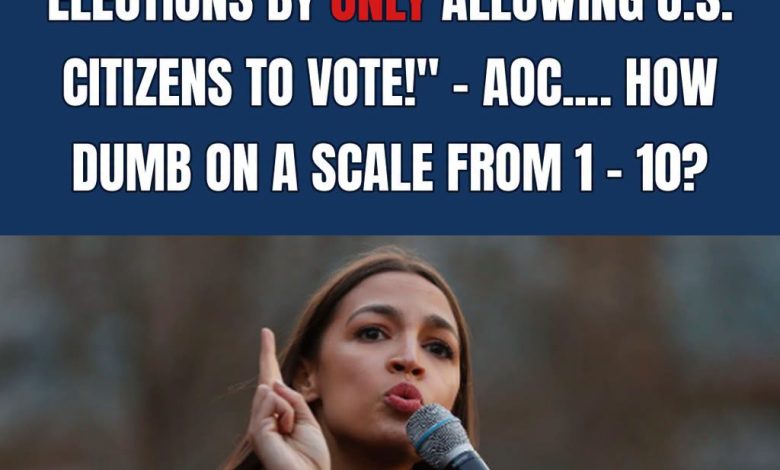
The viral claim that Representative Alexandria Ocasio-Cortez accused Republicans of “rigging elections” by allowing only citizens to vote illustrates the danger of political misinformation. Fact-checkers found that she did not make the statement attributed to her. Americans can debate her positions on local voting laws or proof-of-citizenship requirements without relying on a fabricated quotation.
Election integrity cannot be built on inaccurate information. It requires enforceable citizenship rules, reliable registration systems, transparent audits and fair procedures that protect lawful voters.
American citizenship carries important constitutional and civic responsibilities. Protecting the citizen’s ballot is therefore a legitimate national priority. But the strongest defense of that principle is not outrage built on viral rumors. It is a system that can demonstrate—with verifiable records, careful audits and public accountability—that every legal vote is counted and every ineligible vote is rejected.
The goal should be simple: citizen-only federal voting, accurate voter rolls and election rules that Americans across the political spectrum can trust.