Trump’s Warning Against Communism Strikes at a Deeper American Debate
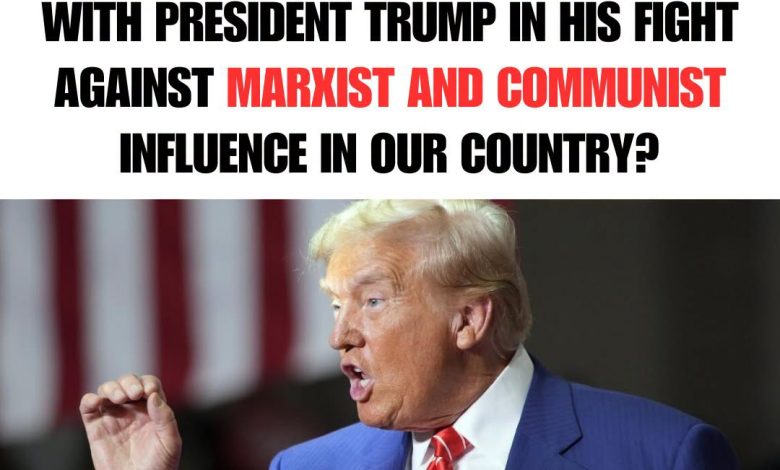
President Donald Trump has repeatedly delivered a direct warning about one of history’s most destructive political systems: “Communism ruins everything it touches.”
For many conservative Americans, that statement is more than campaign rhetoric. It reflects a broader concern that ideas associated with centralized government power, forced economic equality, political censorship, and ideological conformity are gaining influence within American institutions.
History provides powerful reasons for skepticism toward communist rule. The Soviet Union’s prison camps, Mao Zedong’s disastrous Great Leap Forward, Fidel Castro’s authoritarian government in Cuba, and Venezuela’s economic and political collapse all demonstrate the dangers of concentrating enormous power in the hands of the state.
These governments differed in important ways, but they shared several recurring characteristics: restrictions on individual freedom, suppression of political opposition, weakened property rights, economic dysfunction, and extensive government control over everyday life.
A Cultural Conflict Inside American Institutions
The United States is not a communist country, and political disagreements within a democracy should not automatically be labeled communism. Nevertheless, many conservatives believe that certain modern progressive movements reflect similar assumptions about power, equality, and social control.
They point to debates surrounding critical race theory, diversity mandates, immigration enforcement, identity politics, censorship, and merit-based standards as evidence that American institutions are moving away from individual responsibility and equal treatment under the law.
Supporters of these policies argue that they are intended to correct discrimination and expand opportunity. Critics respond that such programs can divide citizens into competing identity groups, weaken objective standards, and give institutions excessive authority over speech and personal beliefs.
That distinction matters. The serious debate is not whether every progressive policy is literally communist. It is whether policies built around compelled conformity, state dependency, ideological enforcement, or collective guilt undermine the principles of a free society.
Education, Family, and National Identity
Concern is especially strong in education. Many parents believe schools should focus on academic achievement, civic knowledge, critical thinking, and practical skills rather than political activism.
When students are taught to view their country primarily through oppression, inequality, and historical guilt, critics fear that education becomes indoctrination rather than instruction. They argue that young Americans should learn the nation’s failures honestly while also understanding its constitutional achievements, democratic institutions, and capacity for reform.
Conservatives also connect declining social trust and family instability to a wider cultural rejection of traditional institutions. Although complex problems such as falling birth rates and educational decline cannot be blamed on a single ideology, they raise legitimate questions about whether American society is preserving the foundations necessary for long-term stability.
Trump’s Political Counteroffensive
Trump’s agenda presents itself as a direct challenge to these cultural and institutional trends. His supporters see his positions on parental rights, online censorship, border security, religious liberty, gender policy, and government bureaucracy as part of a broader effort to limit ideological control.
To them, the issue is not merely partisan. It is a struggle over whether citizens or institutions will exercise greater authority over family life, education, speech, and economic opportunity.
Critics of Trump argue that his rhetoric can oversimplify complicated policy disputes and encourage excessive polarization. That criticism deserves consideration. Not every government program is socialism, and not every left-wing proposal leads inevitably to dictatorship.
At the same time, dismissing all concerns about ideological coercion would also be a mistake. History shows that freedom is rarely lost in a single dramatic moment. It is often weakened gradually as governments and powerful institutions claim greater authority in the name of fairness, security, or social progress.
The Principles at Stake
America’s prosperity was built largely upon individual liberty, private property, constitutional government, free enterprise, strong civic institutions, and limits on state power.
These principles do not guarantee a perfect society. They do, however, allow citizens to speak freely, build businesses, challenge leaders, worship according to conscience, and pursue opportunity without requiring government permission.
The central choice facing Americans is therefore larger than any single politician. It is whether the country will preserve a system that protects individual rights or continue expanding institutional power over economic, cultural, and personal life.
Trump’s warning resonates because the historical record of communism is impossible to ignore. Whenever political leaders promise equality by eliminating freedom, ordinary citizens eventually pay the price.
America should address injustice and expand opportunity, but it must do so without abandoning the liberties that make reform possible. The strongest defense against authoritarian ideology is not fear or censorship. It is a confident commitment to freedom, accountability, merit, family, constitutional rights, and equal justice under the law.