Father’s Courtroom Outburst Highlights the Human Cost of a Controversial 120-Hour Sentence
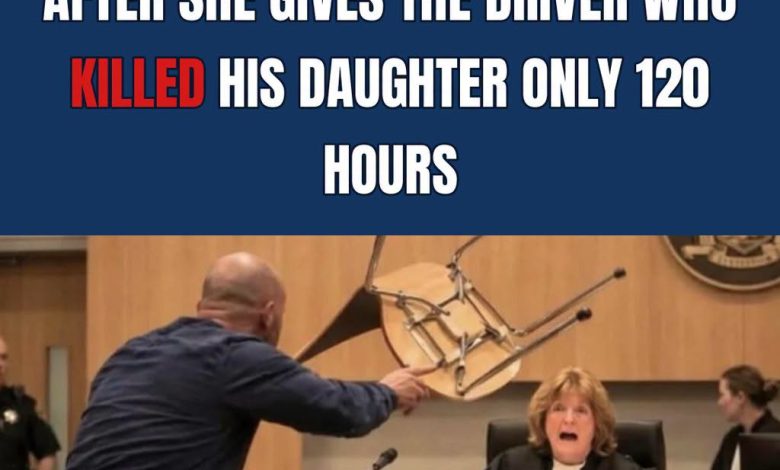
A grieving father’s anger erupted in court after the person responsible for his daughter’s death was reportedly sentenced to only 120 hours—equivalent to five days. The emotional confrontation quickly became a powerful symbol of what many Americans see as a growing disconnect between legal punishment and the devastating consequences suffered by victims’ families.
For a parent who has lost a child, no sentence can reverse the tragedy. However, when the punishment appears dramatically smaller than the harm caused, families may feel that the justice system has failed to recognize the value of the life that was taken.
The father’s reaction reflected more than personal grief. It raised a broader question that courts, lawmakers, and communities must confront:
What does justice require when a reckless or unlawful act ends an innocent life?
Supporters of tougher sentencing argue that penalties must provide accountability, deterrence, and protection for the public. They believe that extremely short sentences risk sending the message that deadly conduct will bring only minor consequences.
The full legal circumstances surrounding the case—including the exact charge, sentencing guidelines, prior record, plea agreement, and any additional probation or restrictions—are essential to evaluating the ruling fairly. Still, the visible anguish of the victim’s family cannot be dismissed as a technical detail.
Victims’ families deserve to be heard, treated with dignity, and given a clear explanation of how a sentence was determined.
Critics of lenient sentencing also warn that public confidence deteriorates when courts appear more focused on reducing punishment than recognizing irreversible harm. A justice system cannot function effectively when ordinary citizens believe that penalties depend more on legal maneuvering than on the seriousness of the outcome.
At the same time, judicial accountability should be based on the complete record rather than political labels alone. Not every controversial sentence is evidence of an “activist judge,” and responsible reform requires examining the relevant statutes, prosecutorial decisions, and sentencing limitations.
Nevertheless, this father’s courtroom anguish has forced renewed attention on an issue that crosses party lines. Americans may disagree about criminal-justice policy, but most agree on one basic principle:
When a life is taken, the legal consequences should reflect the gravity of that loss.
Lawmakers should review whether current sentencing laws adequately protect the public and respect victims. Prosecutors should explain plea agreements transparently, and judges should clearly state how their decisions serve justice.
The father’s fury cannot restore his daughter. But it can serve as a reminder that behind every court file is a family living with permanent loss—and that justice must be credible not only in legal language, but also in the eyes of the people it is supposed to protect.