Religious Freedom Should Not Override a Community’s Right to Peace
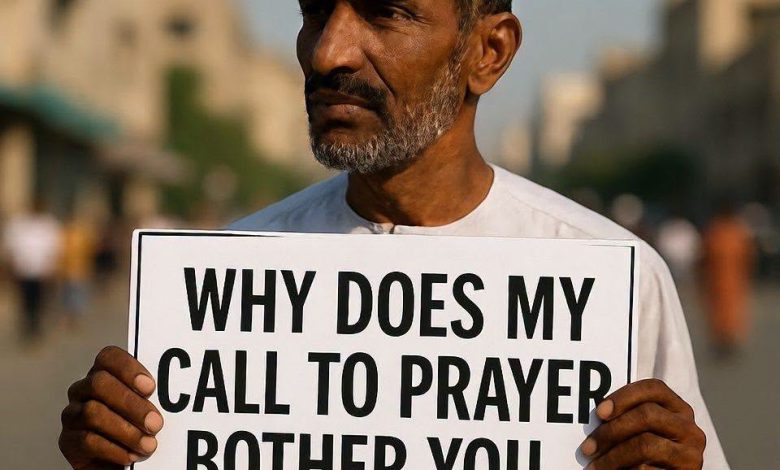
Across the United States, communities are debating whether amplified religious broadcasts—including the Muslim call to prayer—belong in residential neighborhoods. The issue deserves a serious discussion, but it should not be reduced to hostility toward one faith.
The central question is straightforward: Should any religious institution be permitted to broadcast amplified messages at a volume or hour that substantially disrupts nearby residents?
Americans enjoy broad protections for religious belief and worship under the First Amendment. Those protections are essential. However, religious liberty does not automatically exempt churches, mosques, synagogues, temples, or other institutions from reasonable noise regulations.
Families should not have to endure excessive amplified sound early in the morning or repeatedly throughout the day, regardless of whether it comes from a call to prayer, church bells, outdoor preaching, concerts, political demonstrations, or commercial advertising.
One Standard for Every Institution
Local governments should adopt content-neutral rules based on measurable factors such as:
- Volume and decibel levels
- Duration and frequency
- Time of day
- Distance from homes, schools, and hospitals
- Documented disruption to residents
The same rules must apply equally to every religious and nonreligious organization. Authorities should neither grant special privileges to minority faiths nor impose discriminatory restrictions on them.
Equal enforcement is not intolerance. It is the rule of law.
When officials dismiss every neighborhood complaint as prejudice, they undermine public trust. At the same time, residents weaken their own argument when they describe an entire religion or immigrant population as an invading force. Legitimate concerns about noise should be supported by evidence—not assumptions about the motives or loyalty of millions of people.
Assimilation Requires Mutual Responsibility
Immigrants have helped build the United States, but successful immigration also requires respect for the laws, customs, and civic expectations of the country they enter.
That responsibility applies to everyone. Religious communities should consider how their practices affect neighbors who do not share their beliefs. Local residents, in turn, should distinguish between peaceful religious observance and conduct that creates a genuine public disturbance.
Accommodation cannot be entirely one-sided. A pluralistic society works only when different groups exercise their freedoms with restraint and respect for others.
Protecting Both Liberty and Tranquility
American communities do not need to choose between religious freedom and peaceful neighborhoods. They can protect both by enforcing carefully written noise ordinances without favoring or targeting any particular faith.
No religious institution should dominate the public soundscape. No religious group should be singled out because its beliefs are unfamiliar.
The responsible solution is not collective blame or government favoritism. It is clear limits, equal treatment, transparent enforcement, and respect for every resident’s constitutional rights.
That approach protects America’s civic traditions far more effectively than either unrestricted amplification or religious hostility.