WASHINGTON REPUBLICANS FACE A TEST: DELIVER ON ELECTION INTEGRITY OR EXPLAIN THE FAILURE
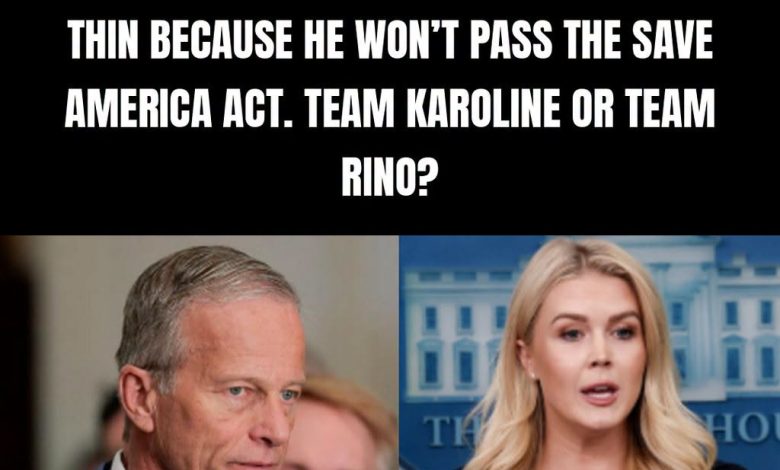
The widening dispute between President Donald Trump’s White House and Senate Majority Leader John Thune is about far more than one piece of legislation. It is becoming a test of whether Washington Republicans can convert their campaign promises into law—or whether conservative voters will once again be handed procedural explanations instead of results.
White House Press Secretary Karoline Leavitt made the administration’s frustration unmistakable, saying that President Trump’s patience with the Senate’s handling of the SAVE America Act was “running out.” Trump wants as much of the election legislation enacted as possible before the Senate leaves for its August recess.
The legislation includes major Republican priorities such as photo identification requirements and proof-of-citizenship rules for voter registration. House Republicans have advanced portions of the agenda through several legislative vehicles, including the defense authorization bill, a congressional stock-trading proposal and a budget resolution designed to open a possible reconciliation pathway.
For millions of conservative Americans, the principle is straightforward: only eligible American citizens should decide American elections. Voters who placed Republicans in control did not do so merely to hear speeches about election integrity. They expected Congress to act.
That is why Leavitt’s criticism has resonated with a Republican base exhausted by years of delay.
THUNE’S EXPLANATION MAY BE PROCEDURALLY CORRECT—BUT IT IS NOT POLITICALLY SUFFICIENT
Thune has pushed back against the White House, arguing that Republicans simply do not possess the votes necessary to pass the full legislation under normal Senate rules. Most major bills require 60 votes to overcome a filibuster, while Republicans hold only a 53-seat majority.
Thune has also said that incorporating election provisions into budget reconciliation would require careful restructuring to comply with Senate rules. He acknowledged that he could not currently identify even 50 votes for the relevant budget strategy.
Those are real constraints. A Senate majority leader cannot manufacture votes that do not exist.
But leadership is not merely the act of counting votes after senators have already made their decisions. Leadership means developing a strategy, applying pressure, forcing public votes, negotiating without surrendering the central objective and making every reluctant lawmaker answer to the voters.
Conservatives therefore have a legitimate question for Thune: What is the plan?
Telling the country that the votes are unavailable cannot be the final answer. Republican leaders must identify who is opposing the legislation, what provisions are creating resistance and what pressure will be applied to move the bill forward.
ACCOUNTABILITY IS NOT THE SAME AS BLIND LOYALTY
Some commentators have described Thune’s conduct as a deliberate betrayal of Trump. That conclusion goes beyond the publicly established facts.
The available evidence shows a serious disagreement over strategy, timing and Senate mathematics. It does not establish that Thune secretly supports Democratic election policies or is intentionally sabotaging the president.
However, rejecting an unproven accusation does not excuse weak performance.
Republican leaders should be judged by measurable results. Did they schedule the vote? Did they force senators to declare their positions? Did they use every lawful legislative tool? Did they communicate honestly with voters? Did they preserve the essential provisions rather than negotiate them into meaninglessness?
Those are the standards that matter.
Conservative voters should not accept excuses merely because they come from Republican officials. But neither should they replace evidence with assumptions about hidden motives. A serious political movement must be capable of demanding accountability without abandoning factual discipline.
LEAVITT IS EXPRESSING A DEEPER CONSERVATIVE FRUSTRATION
Leavitt’s confrontation with Senate leadership reflects a frustration that has been building for years.
Republicans campaign on securing the border, restoring confidence in elections, reducing federal overreach and confronting entrenched Washington interests. Yet when the time comes to legislate, voters repeatedly hear about parliamentarians, procedural limitations, narrow margins and the need to wait for a more favorable moment.
Procedures matter in a constitutional republic. But procedures cannot become a permanent shelter for political inaction.
The House has already moved portions of Trump’s election agenda through multiple bills. The Senate must now demonstrate whether it intends to develop a viable path forward or simply explain why one cannot exist.
If the legislation truly lacks sufficient Republican support, the public deserves to know which senators are withholding their votes and why. Transparency would allow Americans to distinguish between unavoidable institutional barriers and failures of political courage.
THE MOVEMENT NEEDS RESULTS, NOT A REPUBLICAN CIVIL WAR
A public war between the White House and Senate Republicans could ultimately benefit Democrats by dividing the conservative coalition before the midterm elections. Several Republican senators have already warned that the confrontation risks becoming a damaging internal fight.
But unity cannot mean silence.
Republican unity must be built around a shared program, not around protecting powerful officials from criticism. Thune deserves a fair assessment of the obstacles he faces, but he also owes the president and Republican voters a concrete strategy for overcoming them.
Trump was elected to challenge the habits of Washington. Leavitt’s message reflects the administration’s belief that congressional leaders must operate with the same urgency.
The central question is not whether Thune is sufficiently loyal to one personality. It is whether Senate leadership is sufficiently committed to the agenda Republicans promised the country.
THE BOTTOM LINE
American conservatives should demand three things:
Force lawmakers to take clear positions. Use every legitimate legislative avenue. Tell voters the truth about who is blocking the bill.
No leader should be condemned on the basis of speculation. But no leader should be protected from accountability by Senate tradition, party seniority or procedural jargon.
The SAVE America Act dispute has exposed the distance that can exist between winning an election and governing effectively. Closing that distance will require more than angry statements from the White House or defensive answers from Capitol Hill.
It will require strategy, transparency and political courage.
Republican voters have heard enough promises. Now they are waiting to see who can deliver.