Cremation Explained: What Really Happens and What Families Need to Know
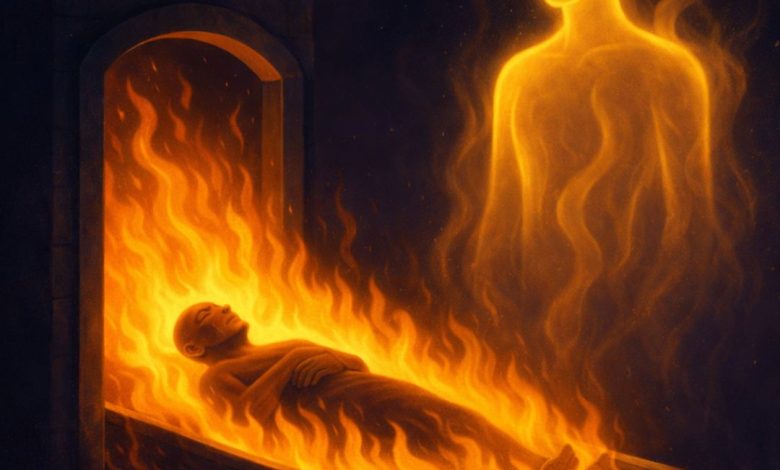
Cremation is the process of incinerating a deceased person’s body at extremely high temperatures, leaving behind a small amount of cremated remains (“ashes”) that families may keep, bury, or scatter. While cremation is still taboo in some cultures and religions, it has become more common in recent years, and that shift has brought a wave of questions—many of them driven by misunderstanding and fear of the unknown.
A former funeral home worker named Lauren (who shares educational content online) has helped normalize these conversations by explaining what really happens and addressing the concerns families are often too nervous to ask out loud.
Why cremation can feel frightening
People are often uneasy about cremation because:
- They don’t know the step-by-step process
- They worry about safety and dignity
- They fear mistakes, especially around identification
- They wonder about spiritual implications, including what happens to the soul
The good news is that modern cremation follows strict, documented procedures designed to protect both accuracy and respect.
“How do I know the ashes are really my loved one?”
This is one of the most common and emotionally charged questions families ask. According to Lauren, crematories use clear identification safeguards from start to finish:
- A unique metal ID plate with a specific number is assigned when the body arrives.
- That ID plate stays with the person throughout the entire cremation process.
- After cremation, the remains are placed into a bag or container with matching identification.
- Families receive a cremation certificate that lists the person’s name and registration/ID number.
In practical terms, families are reassured because the identification system is designed to follow the person continuously, not just at the beginning or end.
What happens before cremation: safety checks and strict protocols
Before cremation begins, there are important steps to ensure the process is safe and properly managed:
- Coffins are inspected for items that cannot be burned, including certain metals.
- Pacemakers must be identified and removed because they can explode under extreme heat and may even damage the cremation chamber.
- If an autopsy is performed, it typically happens before cremation.
- Personal and medical items are handled according to facility rules, legal requirements, and family consent, with the goal of maintaining dignity and respect throughout.
The questions people are afraid to ask
Some questions sound unusual, but they come from genuine concern. For example, people sometimes ask whether items like tampons are removed if someone dies during menstruation. Lauren explains that, in many cases, an autopsy or preparation process occurs before cremation, and such items are typically removed—especially when embalming is involved—following clear protocols and only with appropriate consent.
The key takeaway is that cremation services are structured to be:
- Documented
- Regulated
- Safety-focused
- Respectful of the deceased and the family
The bigger question: what happens to the soul?
Even when the mechanics of cremation are understood, many people still struggle with the spiritual side. Different religions and belief systems answer this differently, and for many families, these beliefs guide whether cremation feels acceptable—or not.
1) Hinduism and Buddhism: cremation as a spiritual transition
In Hinduism, cremation is typically the preferred practice. It is believed that:
- The soul (atman) is eternal
- The soul leaves the body at death
- Cremation helps the soul detach from the physical form
- Fire is seen as a sacred purifier
- The soul continues through reincarnation (samsara)
In Buddhism, cremation is also common, but the belief structure differs:
- Buddhism does not emphasize a permanent, unchanging soul
- Instead, it teaches that consciousness continues in a cycle of rebirth
- Cremation can be viewed as a ritual of acceptance and impermanence, honoring the reality that all things change
2) Christianity: faith, resurrection, and changing traditions
Christian views on cremation have evolved over centuries.
- Historically, burial was often preferred, especially due to beliefs about bodily resurrection
- Today, many Christian denominations accept cremation, as long as it does not represent a rejection of faith
- Many Christians believe the soul is judged by God and moves to heaven, hell, or a state such as purgatory
- A central idea is that the method of body care (burial vs. cremation) does not determine the soul’s destiny—rather, faith and one’s relationship with God are what matter most
3) Islam: cremation is prohibited as a matter of dignity and obedience
In Islam, cremation is strictly forbidden. Traditional practice emphasizes:
- Burial as soon as possible after death
- A burial process that is simple, respectful, and dignified
- The belief that the soul leaves the body at death but remains linked to it until the Day of Judgment
- The prohibition of cremation reflects a deep principle: the human body must be honored, even after death
4) Secular and spiritual perspectives: meaning without a single doctrine
Many people today identify as spiritual-but-not-religious or secular. In these views, cremation may be understood as:
- A natural return of the body to the earth
- A symbolic transition where the soul:
- moves to another plane
- becomes one with the universe
- lives on through memory, influence, and legacy
Others—especially those with scientific or humanist perspectives—may believe:
- Consciousness ends at death
- Cremation is primarily a personal, practical, or ecological choice, not a spiritual one
What families can take from all of this
Cremation sits at the intersection of procedure and belief. The process itself is structured to provide:
- Clear identification and tracking
- Safety checks for hazardous items like pacemakers
- Protocols designed to preserve dignity
But the meaning families attach to cremation depends heavily on spiritual worldview. For some, it is a sacred release; for others, a faith-neutral choice; and for some religions, it remains unacceptable.
What matters most is that families feel confident that the process is respectful, accurate, and aligned with their values—because in the end, cremation is not only a technical procedure, but also a deeply human moment of goodbye.