FBI Firings Ignite a Larger Battle Over Accountability, Election Integrity and Political Power
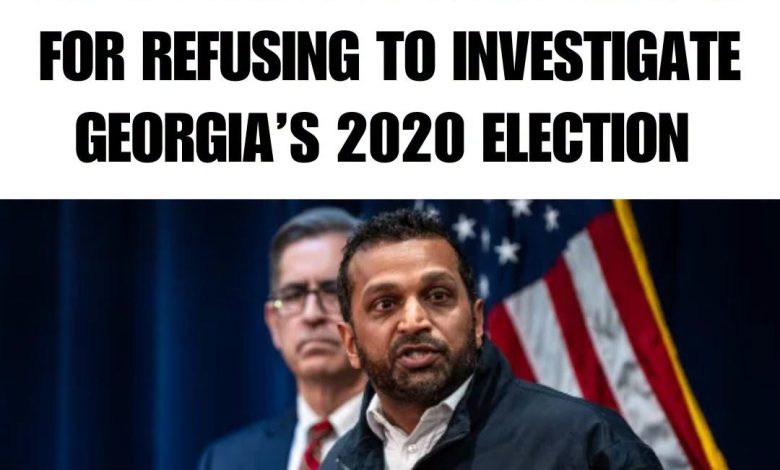
The reported firing of two FBI intelligence analysts in Atlanta has opened a new and consequential debate over the responsibilities of career government employees, the authority of agency leadership and the continuing federal investigation into Georgia’s 2020 presidential election.
According to reporting by MS NOW, the two analysts—a married couple—were dismissed after declining to participate in the election-related investigation. They reportedly argued that the assignment conflicted with established FBI and Justice Department policies. The FBI has not publicly released a detailed explanation of the personnel decisions.
The dispute comes as FBI Director Kash Patel has redirected substantial resources toward the Georgia investigation. Reports indicate that approximately 260 analysts from offices across the country were assigned to review election records and other materials seized from Fulton County. Federal agents reportedly collected hundreds of boxes containing ballots and related documents during a court-authorized search.
For supporters of President Donald Trump, the firings represent something long overdue: federal employees being required to carry out lawful assignments rather than substituting their personal or institutional judgment for the decisions of elected leadership and duly appointed agency officials.
The principle is straightforward. Career employees are entitled to raise legitimate legal or ethical concerns through appropriate channels. But government agencies cannot function effectively when individual employees simply refuse assignments because they disagree with the political implications of an investigation.
At the same time, the administration must demonstrate that its actions are based on law, evidence and consistent personnel standards. A search warrant authorizes investigators to obtain potential evidence; it does not establish that election fraud occurred or that anyone committed a crime. Any disciplinary action should therefore be supported by documented insubordination or misconduct—not merely by disagreement with the administration’s political priorities.
That distinction matters because Georgia’s 2020 election has already undergone extensive scrutiny. The state conducted multiple counts, including a statewide hand audit, and previous investigations did not establish fraud on a scale capable of changing the certified result. President Trump and his supporters nevertheless maintain that unresolved questions about election administration, ballot handling and transparency deserve further examination.
Those two facts are not mutually exclusive. The absence of proven outcome-changing fraud does not mean election systems should be immune from further review. But the existence of unanswered questions also does not justify declaring an election stolen before evidence supports that conclusion.
Sen. Mark Warner, the ranking Democrat on the Senate Intelligence Committee, has criticized the investigation, arguing that it diverts FBI personnel from national-security and law-enforcement responsibilities. In a July 9 letter, Warner said the 2020 Georgia election had already been extensively audited, investigated and litigated.
That criticism deserves consideration, but it does not settle the issue. Congress has every right to examine whether federal resources are being used responsibly. The executive branch, however, also possesses broad authority to determine investigative priorities, provided those investigations remain within constitutional and statutory limits.
The more troubling question is whether political disagreement is being confused with professional misconduct on either side.
An FBI analyst should not be punished merely for identifying a genuine legal or procedural concern. But an analyst also cannot claim an unlimited personal veto over a lawful investigation. The proper response is documentation, supervisory review and, when necessary, independent legal evaluation—not anonymous resistance or politically motivated retaliation.
Americans have ample reason to be skeptical of federal institutions. The FBI’s past controversies, partisan accusations and inconsistent handling of politically sensitive cases have damaged public confidence. Restoring that confidence will require more than dramatic firings or sweeping investigations. It will require transparency, verifiable evidence, procedural fairness and equal enforcement of the rules.
Kash Patel now faces a significant test. If the dismissed analysts refused a lawful directive without adequate justification, disciplinary action may have been warranted. If they were removed for raising legitimate policy objections through authorized channels, the firings could deepen concerns that the FBI is being transformed into a political instrument.
The administration should therefore disclose as much information as personnel and investigative rules permit. It should explain the legal basis of the Georgia inquiry, the standards governing employee participation and the reasons such a large number of analysts were reassigned.
Election integrity is too important to be reduced to slogans from either party. Americans deserve elections that are secure and transparent. They also deserve an FBI that follows evidence instead of political pressure.
Accountability must apply to everyone: election officials, federal investigators, career employees and political appointees alike. That is how public trust is rebuilt—not through unquestioning obedience, but through lawful authority supported by demonstrable facts.