Finger Length and Personality: Viral “Test” vs Scientific Evidence
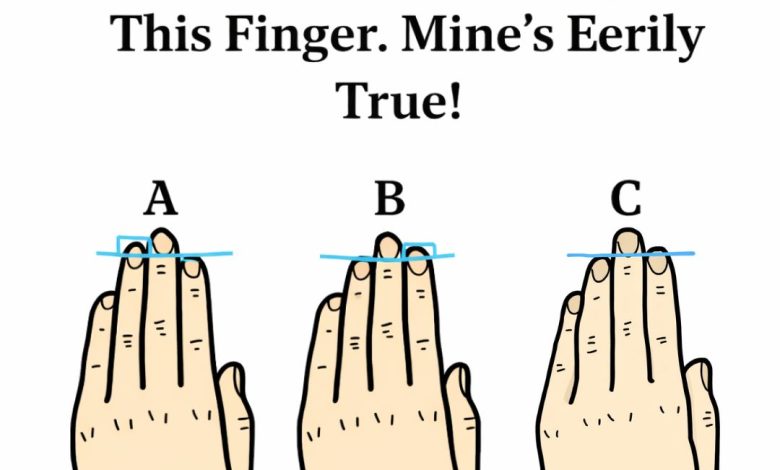
A popular finger-length test claims you can learn something about your personality by comparing your index finger (2nd digit) and ring finger (4th digit). The idea is simple, quick, and often surprisingly “accurate” to people who try it—but the science behind it is far more nuanced.
The 30-Second Finger Check (How To Do It)
- Put one hand flat with your palm facing up (or look at the back of your hand—either works as long as you compare tips clearly).
- Compare the tip height of your index finger and ring finger.
- Identify which of these looks most like your hand:
- Ring finger longer than index finger
- Index finger longer than ring finger
- About the same length
Tip: Many people notice small differences between their left and right hands, so it can be useful to check both.
What the Viral Interpretations Usually Claim
These are the most common “personality” descriptions you’ll see attached to each outcome. Treat them as fun patterns, not hard rules.
1) Ring Finger Longer Than Index Finger (Lower 2D:4D)
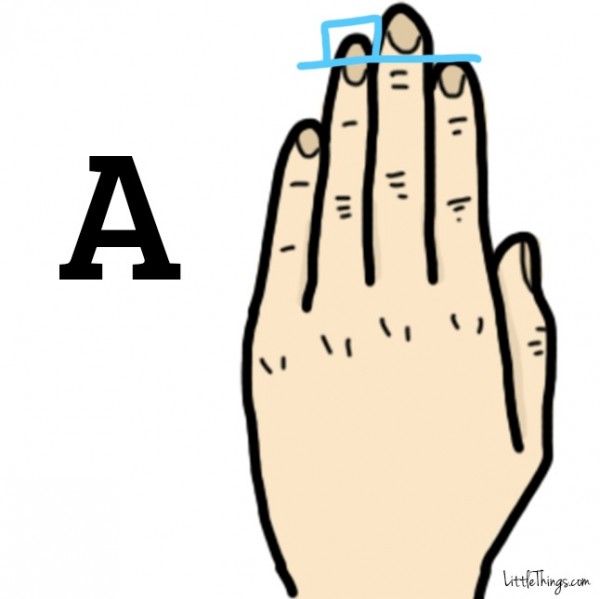
Often described as:
- More competitive and confident
- More comfortable with risk and fast decisions
- Direct communicator, sometimes more assertive
- Drawn to challenges, novelty, and “high-energy” environments
Research note: Lower 2D:4D has been studied as a possible marker connected to prenatal hormone balance, but links to adult behavior are typically small and inconsistent across studies.
2) Index Finger Longer Than Ring Finger (Higher 2D:4D)

Often described as:
- More empathetic and cooperative
- Thoughtful and cautious with decisions
- More likely to prefer structure, planning, and reflection
- Strong “listener” tendencies and relationship focus
Research note: Some work has reported associations between 2D:4D and certain personality dimensions (e.g., emotion-related traits), but findings vary by sample, measurement method, and even which hand is measured.
3) Index and Ring Fingers About the Same Length
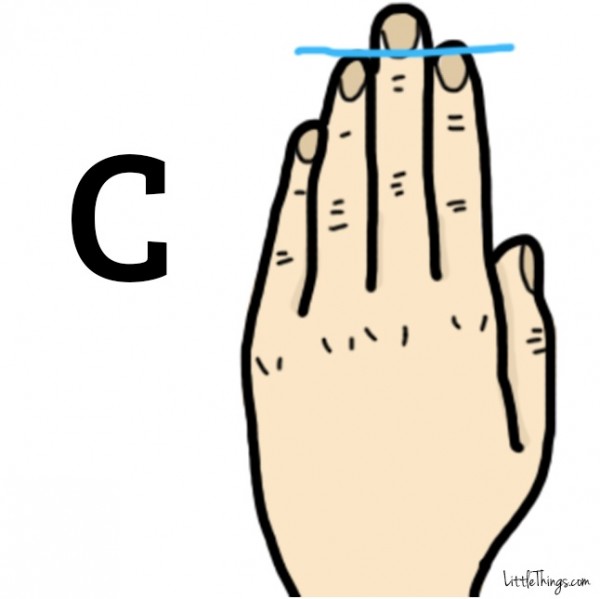
Often described as:
- Balanced temperament
- Adaptable: can be social but also independent
- More likely to “read the room” and adjust style
- Conflict-averse, or skilled at mediation
Research note: This “balanced” category is mainly a popular interpretation; research usually treats finger lengths as a ratio on a continuum, not discrete personality types.
Where This Idea Comes From: The 2D:4D Ratio
Scientists call this comparison the 2D:4D ratio—the length of the index finger (2D) divided by the length of the ring finger (4D).
Common assumptions in this research area include:
- Lower 2D:4D is often hypothesized to reflect higher prenatal androgen (testosterone) influence relative to estrogen.
- Higher 2D:4D is often hypothesized to reflect relatively lower prenatal androgen influence.
However, a major caution: even though 2D:4D is widely used as a proxy, evidence for how well it tracks prenatal hormone exposure is not definitive, and some rigorous work suggests the relationship may be weaker than many people assume.
What Research Suggests (In Plain English)
The best overall takeaway is:
- There may be statistical links between 2D:4D and certain behavioral or personality variables in some groups.
- But those links tend to be small, and different studies often find different results.
- Context matters: effects can depend on sex, age, culture, measurement accuracy, and the specific trait being tested.
Examples of findings researchers have reported:
- Large datasets in experimental settings have found that 2D:4D does not reliably predict risk-taking choices in the straightforward way viral claims suggest.
- One large cohort study reported an association between lower 2D:4D and higher sociability / larger social networks in men—while also emphasizing that prior results across the field can be inconclusive.
- Studies in high-risk sport samples have found patterns that look less like “fearless risk-takers” and more like differences in precaution/attention under risk, plus links to traits such as conscientiousness and agreeableness.
- In a sample of young women, 2D:4D showed a relationship with emotional stability and impulse/emotion control, while other Big Five dimensions showed no clear association.
How To Measure More Accurately (If You Want Numbers)
If you want to go beyond eyeballing:
- Place your hand flat.
- Measure each finger from the middle of the bottom crease (where the finger meets the palm) to the fingertip.
- Compute 2D:4D = (index length) ÷ (ring length).
- If the result is less than 1, ring finger is longer.
- If it’s greater than 1, index finger is longer.
- If it’s very close to 1, they’re similar.
Be consistent: small differences in where you start measuring can change the ratio.
The Bottom Line
- Finger length can be an interesting biological marker, and it has been studied in relation to hormones and behavior.
- But using it as a “personality decoder” is best viewed as a light, conversation-starting quiz, not a scientific assessment.
- If you want a more reliable read on personality, validated tools (Big Five inventories, for example) are far more informative than finger measurements.