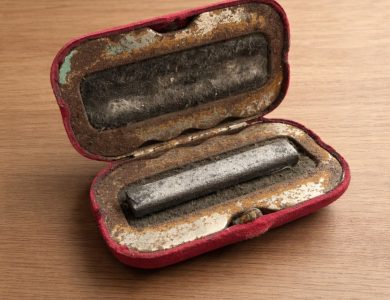
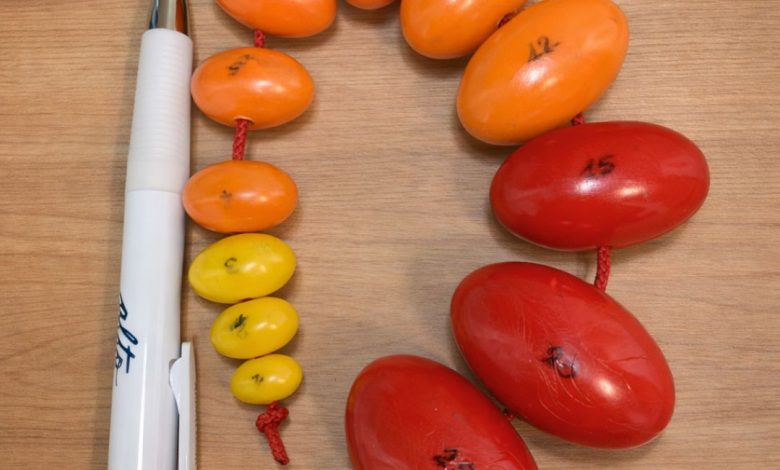
Found On Counter In Medical Exam Room: String Of Plastic Numbered Oval Beads. My Own Doc Had No Idea. Pen For Scale.
What it’s called
An orchidometer is a medical instrument used to estimate testicular volume (in milliliters, mL) by comparison. The best-known version is the Prader Orchidometer, named after its developer.
When it was introduced
The Prader Orchidometer was introduced in 1966 by Swiss pediatric endocrinologist Andrea (Andreas) Prader at the University of Zurich.
What you’re seeing in the images
The device typically appears as a string/chain of oval beads (often wooden or plastic), sometimes stored with a small pouch for portability. Each bead is numbered and represents a specific volume.
What it measures and what it’s for
Clinicians use an orchidometer to:
- Estimate testicular volume in mL during a physical exam
- Track growth and pubertal development over time
- Support evaluation when development appears early, late, or atypical
How the Prader Orchidometer works (simple steps)
- The clinician visually compares the patient’s testis to the oval beads.
- They select the bead that most closely matches in size.
- The printed number on that bead is recorded as the estimated volume (mL).
Typical bead set and range
Most Prader orchidometers include 12 beads, graded from about 1 mL up to 25 mL.
Color coding and what it generally indicates
Many sets are color-coded to reflect common clinical groupings:
- Pre-pubertal (often yellow): 1–3 mL
- Pubertal (often orange): 4–12 mL
- Adult range (often red): 15–25 mL
Why testicular volume can matter clinically
Differences in size—especially if they don’t match other signs of maturation—can be a useful clue in medical evaluation. Common clinical interpretations include:
- Smaller-than-expected volume may suggest primary or secondary hypogonadism (depending on the broader clinical picture).
- Volume patterns can help clinicians distinguish types of early puberty in some cases.
- Because testicular growth is often an early physical marker of true puberty, it’s frequently used to confirm pubertal onset when puberty seems delayed.
- Unusually large testicular volume (macroorchidism) can be one of the clinical clues considered in certain conditions, including fragile X syndrome.
Practical advantages and limitations
- Advantages: quick, portable, low-cost, and useful for trend tracking across visits.
- Limitations: it is an estimate (comparison-based), so precision can vary; in some settings, ultrasound may be used when more exact measurement is required.
Important note on appropriate use
The orchidometer is intended for trained healthcare professionals as part of a private, clinical examination and should be interpreted alongside other medical findings.