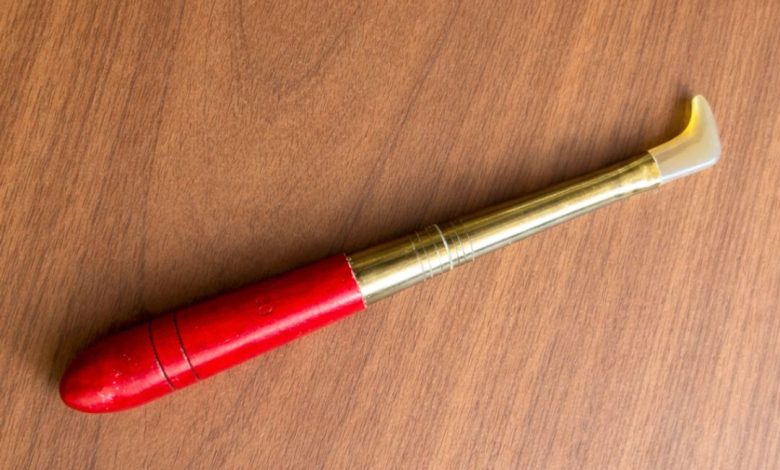
Have no idea what this is, found in my father’s dresser drawer.
What It’s Called
- Name: Agate burnisher
- Also known as: gilding burnisher, gold-leaf burnisher, water-gilding burnisher
- Key identifying feature: a smooth, hard agate stone tip (often looks like glass), mounted on a handle.
What You’re Seeing in the Photo
- Tip: a curved, translucent “glass-like” tip that is agate (a hard, polished stone).
- Body: a metal ferrule/shaft (commonly brass or steel) connecting the tip to the handle.
- Handle: a shaped handle (often wood), designed for control and pressure during burnishing.
What It’s Used For
An agate burnisher is used to create a high-gloss, mirror-like shine on gold leaf and other metal leaf finishes.
It is especially associated with:
- Water gilding (traditional gilding over a prepared ground such as gesso and bole)
- Illuminated manuscripts and fine book arts
- Picture frames, icons, religious objects, furniture ornament, and decorative panels
- Restoration and conservation work where authentic finishes matter
How It Works (Plain-English Explanation)
Burnishing is not “polishing” in the modern abrasive sense. Instead, it’s a controlled compressing action:
- The gold leaf is applied and properly set (often over bole in water gilding).
- The artisan rubs the surface with the smooth agate tip using firm, even pressure.
- The gold leaf is compressed and smoothed, increasing reflectivity until it becomes bright and mirror-like.
Why Agate Is the Preferred Tip Material
- Hardness and smoothness: Agate can be polished extremely smooth, producing a high shine without scratching when used correctly.
- Low porosity: It doesn’t shed grit the way some softer stones can.
- Durability: It holds its polished surface for a long time with proper care.
- Precision: The shaped tip can reach curves, corners, and detailed ornament.
When It First Appeared (Historical Timeline)
There isn’t one exact “birthday,” but the tool’s history is closely tied to gilding itself:
- Ancient world: Gold leaf was used in decorative arts thousands of years ago; early burnishing was done with various hard, smooth materials (bone, tooth, stone).
- Medieval period (manuscripts): Burnishing became a highly refined technique in illuminated manuscript production, where gold areas were burnished to catch light dramatically.
- Early modern to 18th–19th centuries: Agate-tipped burnishers became especially common as specialized craft tools for gilders, bookbinders, and frame makers.
- 20th century to today: The basic design remains largely unchanged because it works exceptionally well.
Who Created It
- Not attributed to a single inventor.
The agate burnisher is a craft tradition tool, developed and refined over centuries by gilders, bookbinders, and decorative artisans. - What likely happened is gradual improvement:
- artisans experimented with different burnishing materials
- agate became a favored standard because it offered consistent results and long-term durability
Practical Tips and Common Uses (Quick List)
- Best for: gold leaf, imitation leaf, and some metal foils (depending on the substrate and technique).
- Most iconic result: high shine on water-gilded surfaces.
- Multiple tip shapes exist: knife-edge curves, pointed ends, and rounded profiles for different details.
Why This Tool Still Matters
Even with modern metallic paints and foils, a properly burnished gold leaf surface has a distinctive look:
- Depth and brilliance that paints rarely match
- A surface that can appear almost liquid under light
- Strong association with heritage craftsmanship and fine restoration work