Internet Stunned by ‘Alien’ Creature When Its True Identity is Revealed
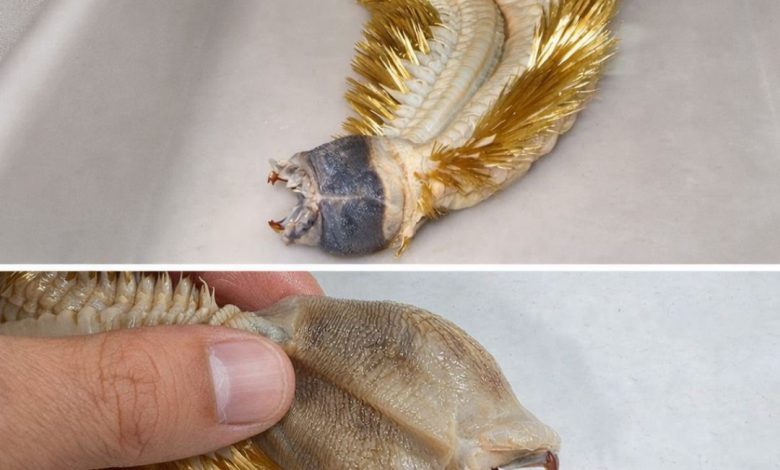
At first glance, the creature spreading across social media looks like a special-effects prop from a sci-fi horror movie. With shimmering golden bristles and a mouth-like opening lined with sharp teeth, it has an unsettling, otherworldly appearance. But this organism is completely real.
It is called Eulagisca gigantea, a marine worm that lives in the cold Southern Ocean near Antarctica. While the images are newly viral, the species itself has been known to science for decades and remains one of the many deep-sea animals that researchers still do not fully understand.
What Is Eulagisca gigantea?
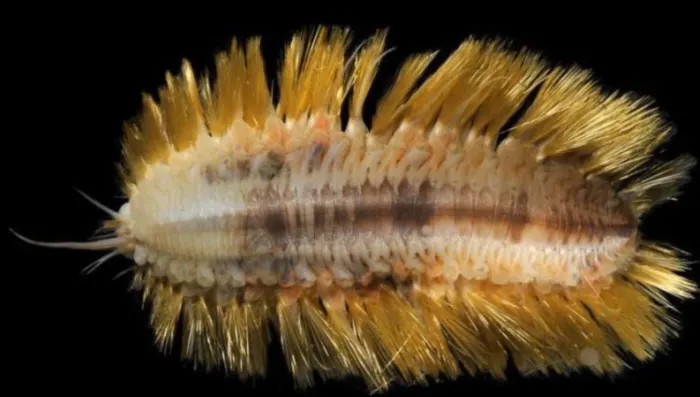
Eulagisca gigantea is part of a group known as polychaete worms, often nicknamed bristle worms because their bodies are covered in stiff, bristle-like structures.
Key identifiers
- Habitat: Antarctic/Southern Ocean waters
- Body: Oval-shaped with golden, shimmering bristles
- Reputation: Looks “alien,” but is a normal part of its ecosystem
A Closer Look at Its “Mouth” and Predatory Design
One of the most confusing features is its terrifying “head.” In reality, what looks like a head is often a retractable pharynx—a structure that can extend outward when the worm feeds.
How it feeds
- The worm extends its pharynx outward.
- Sharp teeth become visible.
- It can grab, hunt, or scavenge other marine life.
Notable detail: This pharynx can extend noticeably, making the animal look even more dramatic in close-up photos.
Why Are the Golden Bristles So Important?
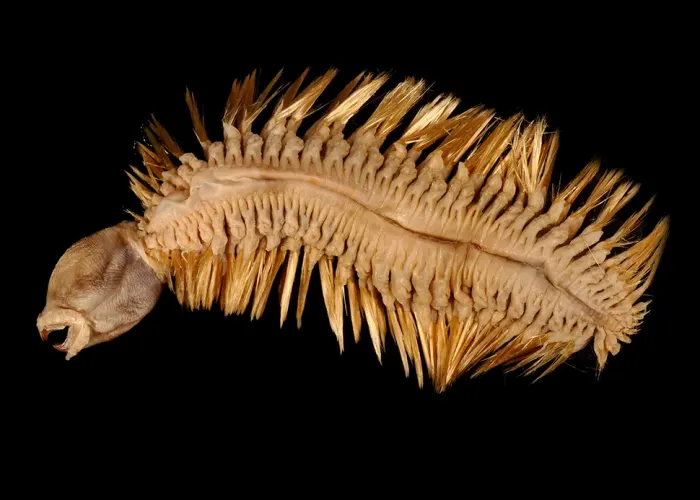
The worm’s bristles are more than decoration. These bristles can help with multiple survival tasks.
Possible functions of the bristles
- Movement: swimming or crawling along the seafloor
- Defense: discouraging predators with a spiky exterior
- Stability: helping the worm navigate rough underwater terrain
Their metallic-gold shimmer is one of the main reasons the animal looks so unusual in photographs.
Why Scientists Still Have Many Questions
Even though the species has been known since 1939, much about its lifestyle remains unclear.
What’s still not well understood
- Daily behavior and movement patterns
- Exact diet (how much is hunting vs. scavenging)
- Reproduction and life cycle
- Population size and distribution in Antarctic waters
This is common for deep-sea and polar species, since observing them in their natural environment is difficult and expensive.
The Bigger Picture: Deep-Sea Diversity Is Vast
Eulagisca gigantea is just one example of how diverse polychaete worms can be. Polychaetes live across a wide range of environments—from shallow reefs to extreme deep-sea zones.
Why polychaetes matter
- They are highly diverse in form, color, and size
- They play essential roles in food webs and ecosystem balance
- They help scientists understand biodiversity in harsh environments
Researchers also believe that many ocean worm species have not yet been discovered, meaning creatures like this may represent only a fraction of what exists in the deep.
Why It Went Viral
The worm’s online popularity surged after striking photos showed:
- Its jaws extended
- The golden bristles glowing
- A dramatic, “monster-like” profile that looked unreal
This mix of real science and shock factor is exactly what fuels viral posts—especially when the animal comes from a remote place like Antarctica.
Conclusion
Eulagisca gigantea may look like a visitor from another planet, but it is a real deep-sea predator adapted to the extreme cold waters near Antarctica. Its viral moment highlights something bigger than social media curiosity: the ocean still contains countless life forms that are strange, spectacular, and not fully understood. As exploration technology improves, more discoveries like this are likely to reshape how we see life beneath the surface.