Poolside Mystery Riddle: Who Isn’t Alive?
The Setup
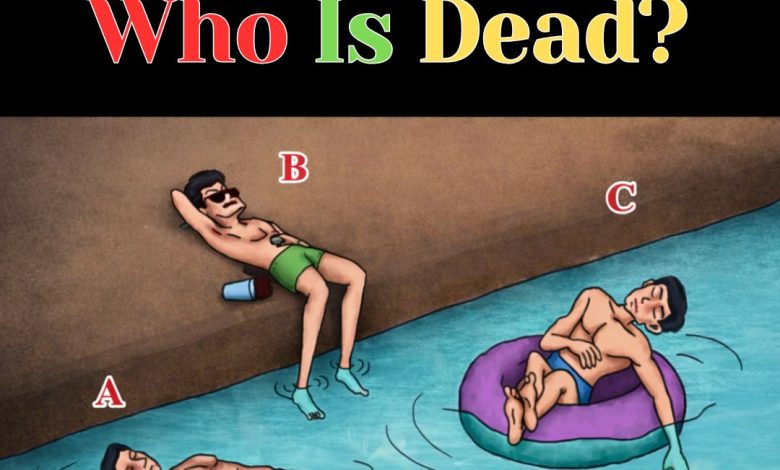
A popular visual riddle shows three people near the water, labeled A, B, and C. At first glance, all three seem to be relaxing—until you look closely and realize the image is asking a darker question: Who is dead?
What You See in the Image
- A is floating in the water, lying flat and motionless.
- B is sitting on the shore with sunglasses on, feet touching the water.
- C is resting on an inflatable ring, one arm hanging down toward the water while holding an object.

Key Clues to Look For
- Body position and support
- A is floating without any support (no float ring, no visible effort to stay above water).
- Signs of activity in the water
- B has water ripples around his feet, suggesting recent movement or shifting.
- C has ripples around the inflatable ring, consistent with natural bobbing and small motion.
- Reaction and control
- C is still positioned securely on the ring, and the scene implies he’s simply resting rather than in distress.
- A shows no sign of active control—no swimming posture, no attempt to stay oriented, and no support.
Answer: The Dead Person Is A
The strongest giveaway is that A is floating motionless in the water with no flotation or active posture, which is presented as the “odd one out” compared with B and C, who both show signs of normal resting behavior and water movement consistent with being alive and shifting position.
Why B and C Are Likely Not the Answer
- B appears relaxed on land, and the water disturbance near his feet suggests he’s still physically present and moving naturally.
- C is supported by an inflatable ring, with surrounding ripples that suggest gentle motion, not complete stillness.
Why This Puzzle Works So Well
- It tricks viewers because all three look “asleep” at first.
- The solution depends on noticing support, movement, and control, not facial expressions alone.