Pop Quiz: What chain needs to break for the brick to fall?
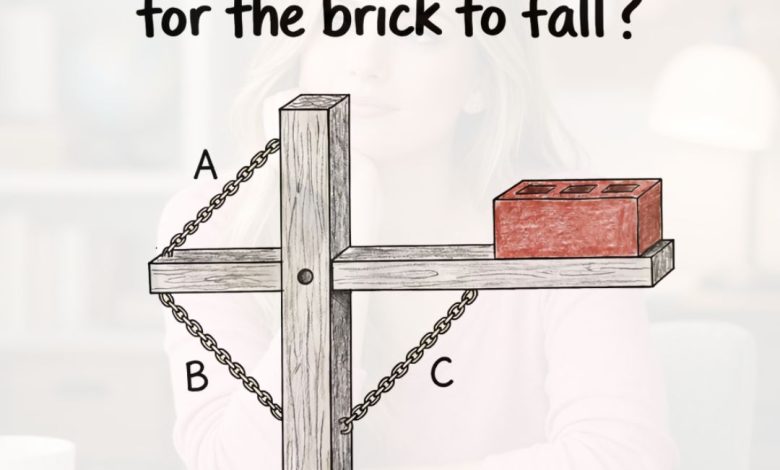
This visual puzzle looks simple, but it tricks many people on their first try. The drawing shows a wooden beam passing through a vertical post, with a brick resting on the right side and three chains labeled A, B, and C helping hold the structure in place.
The big question is: Which chain must break for the brick to fall?

The correct answer is B.
Here is why.
The brick’s weight pulls the right side of the beam downward. If that happens, the left side of the beam rises upward. That movement is the key to solving the puzzle.
Chain B is attached from the left end of the beam to the lower part of the post. As the left side tries to rise, Chain B becomes tight and resists that motion. In other words, B is the chain that actually stops the beam from rotating downward on the brick’s side.
Now look at the other two chains:
Chain A connects the left end of the beam to the top of the post. If the left side rises, that chain actually becomes less important because the distance shortens rather than increases, so it does not stop the beam in the same way.
Chain C is attached on the right side, but when the brick side drops, the geometry causes that chain to loosen rather than hold the beam up. So it is not the chain preventing the brick from falling.
That means only Chain B is truly stopping the downward rotation caused by the brick’s weight.
Final Answer: B
This puzzle is a great example of how weight, leverage, and tension can be misleading at first glance. Many people instinctively pick the chain closest to the brick, but the real answer comes from understanding which chain resists the beam’s actual movement.
So if Chain B breaks, the right side drops, and the brick falls.