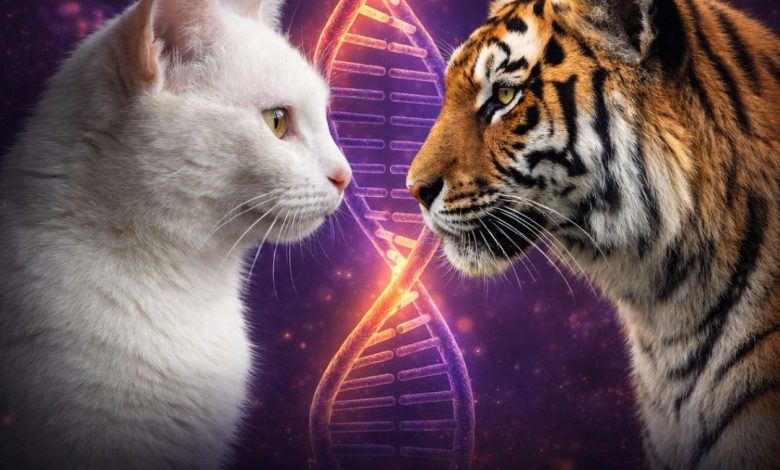
Recent genetic research reveals your house cat shares a staggering 95.6% of its DNA with a wild tiger.
A “Pet” Built on a Predator’s Blueprint
Your house cat may sleep on your bed and beg for treats, but genetically, it is surprisingly close to one of nature’s most powerful hunters. Large-scale genome research reports that domestic cats and tigers share about 95.6% of their genetic material, highlighting how closely related feline species remain at the DNA level.
Why the Similarity Is So High
This strong genetic overlap exists because modern felines descended from a relatively recent common ancestor in evolutionary terms. Even though the size difference is enormous—around 10 pounds for a typical house cat versus up to about 600 pounds for a tiger—both animals are still constructed from a shared biological “template.”
What the Differences Actually Change
The small portion of DNA that differs tends to influence traits such as:
- Body size and growth patterns
- Metabolism and energy use
- Muscle development and physical power
In other words, the differences mostly affect scale and performance, not the core operating system of “how a cat works.”
Why Your Cat Still Acts Wild
That shared genetic toolkit helps explain why domestic cats often show behaviors that look surprisingly “big cat,” including:
- Stalking (slow, focused tracking)
- Pouncing (explosive attack movements)
- Territory marking (scent-based ownership signals)
These are not random habits or “drama.” They are ancient survival instincts—deeply hardwired behaviors inherited from wild ancestors.
What This Means for Cat Owners
Understanding this connection can change how you interpret your cat’s behavior:
- Play is practice: chasing toys mirrors hunting sequences.
- Territory matters: scratching and scenting are communication tools, not “bad attitude.”
- Predator instincts remain strong: even well-fed cats may still stalk, chase, and ambush because the drive is biological.
Bottom Line
Your cat is not just a cute companion. It is a highly refined hunter—genetically close to a tiger, built from nearly the same evolutionary blueprint. The purr and the cuddle are real, but so is the predator underneath.
Source: Montague, M. J., et al. Comparative analysis of the domestic cat genome reveals genetic signatures underlying feline biology and domestication. Nature Communications.