The Berlin Wall’s Enduring Warning About Government Power
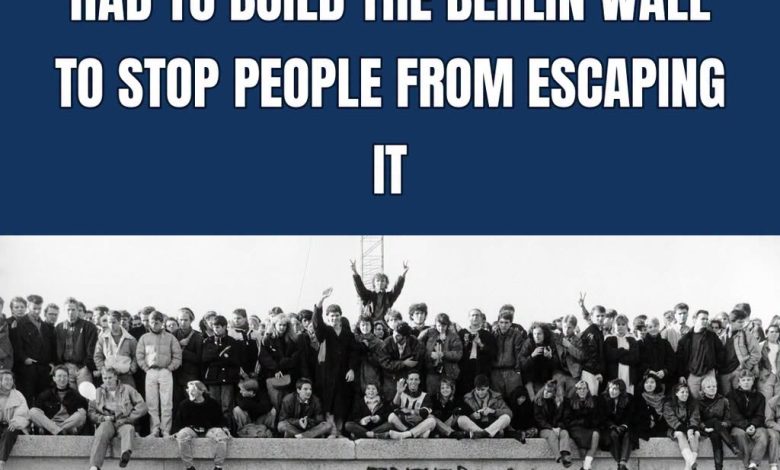
When East German authorities began sealing the border between East and West Berlin on August 13, 1961, they were not building a wall to keep foreign enemies out. They were building it to prevent their own citizens from leaving.
That distinction remains central to understanding the Berlin Wall’s historical significance.
For nearly three decades, the concrete barrier divided neighborhoods, workplaces, friendships, and families. Streets that had once connected communities became fortified zones guarded by fences, watchtowers, armed patrols, and strict travel controls. The wall became one of the most visible symbols of a government that could not retain its population without restricting personal freedom.
East Germany’s communist leadership claimed that the barrier was necessary for national security. In practice, it stopped the large-scale migration of East Germans seeking greater economic opportunity and political liberty in the West.
Before the border was closed, millions had already left East Germany. Many were young workers, skilled professionals, doctors, engineers, and students. Their departure weakened the state and exposed a fundamental problem: people were voting against the system with their feet.
A System Maintained Through Coercion
Life in East Germany was shaped by centralized economic planning, political censorship, limited private ownership, and extensive government surveillance. The Ministry for State Security, commonly known as the Stasi, developed a vast network of informants that monitored citizens, workplaces, schools, and even private relationships.
Public criticism of the ruling party could carry serious consequences. Travel was restricted, elections were not genuinely competitive, and the government controlled much of the press and public discourse.
The division between East and West Berlin also created an unavoidable comparison. West Berlin developed into a prosperous and politically open society, while residents in the East faced shortages, limited consumer choice, and fewer opportunities to determine their own futures.
The wall did not prove that every government program or social welfare policy leads to dictatorship. It demonstrated something more precise: when political leaders combine economic control with unchecked authority, censorship, and restrictions on movement, individual rights become dangerously vulnerable.
The Human Cost of Escape
Despite the risks, many East Germans attempted to cross the border.
Some hid inside vehicles. Others used tunnels, improvised aircraft, concealed compartments, or forged documents. A number of people successfully escaped, but others were arrested, injured, or killed.
Their actions revealed a truth that government propaganda could not erase: human beings will often accept extraordinary danger when they believe dignity, opportunity, and personal autonomy have been taken from them.
The Berlin Wall therefore represented more than a dispute between economic theories. It represented the direct human consequences of a political system that placed the survival of the state above the freedom of the individual.
Lessons Beyond Berlin
The Soviet Union and other authoritarian communist governments followed similar patterns. Centralized leadership promised equality and security but frequently produced censorship, political repression, economic stagnation, and limited freedom of movement.
Modern comparisons should still be made carefully.
Venezuela, for example, has experienced economic collapse, political repression, severe shortages, and the departure of millions of citizens. Socialist economic policies contributed to the crisis, but they were not the only factors. Dependence on oil revenue, corruption, institutional deterioration, price controls, mismanagement, international pressure, and authoritarian rule all played significant roles.
Ignoring those additional causes weakens the argument rather than strengthening it.
The broader lesson is that governments become especially dangerous when they eliminate political competition, undermine independent institutions, weaken property rights, silence criticism, and concentrate economic decision-making in the hands of a small ruling class.
What the Wall Should Teach Americans
Debates over taxation, health care, public education, regulation, and social assistance are legitimate parts of American democracy. Labeling every public program “socialism” can prevent serious discussion and blur important distinctions between democratic welfare policies and authoritarian state control.
At the same time, Americans should remain skeptical of political movements that promise security or equality while demanding ever-greater control over speech, property, economic choices, and personal movement.
The real warning of the Berlin Wall is not simply about the size of government. It is about the absence of limits on government power.
Free societies depend on more than markets alone. They also require constitutional protections, independent courts, competitive elections, freedom of expression, private property, civic responsibility, and institutions capable of restraining political leaders.
When the Berlin Wall fell on November 9, 1989, the world witnessed more than the destruction of concrete and barbed wire. It witnessed the collapse of a system that had tried to contain dissatisfaction rather than correct the conditions that created it.
Families reunited. Citizens crossed a border that had controlled their lives for a generation. A structure designed to appear permanent disappeared because the political system behind it had lost legitimacy.
The wall’s enduring message is clear: a government that must imprison its citizens to preserve its ideology has already revealed the weakness of that ideology.
The strongest societies do not need walls to stop people from escaping. They earn public confidence by protecting liberty, rewarding effort, permitting dissent, and allowing citizens to build their own futures.