90% of people Will Not Know What This Is. Go Ahead And Prove Me Wrong
What You’re Looking At (Name/Type)
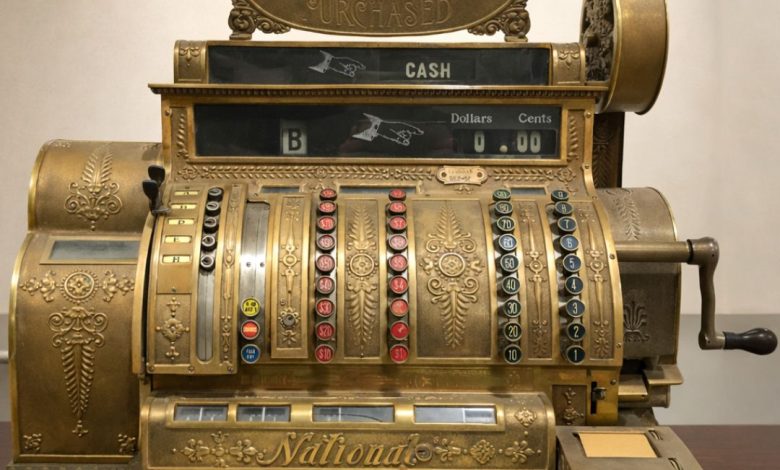
The object in the photos is a vintage “National” mechanical cash register, commonly associated with the National Cash Register Company (NCR). It features a highly decorative brass-bodied register mounted on a wooden cabinet base with multiple drawers (often used for sorting coins, bills, receipts, or department takings).
Notable markings and features visible in the images include:
- “National” branding on the front panel
- A top sign reading “AMOUNT PURCHASED” (a classic sales total display)
- A personalized top plate on one unit reading “C.M. Marshall & Co.” (typically a merchant/owner nameplate)
- A side hand crank used to drive internal mechanisms (often tied to printing/advancing paper and resetting functions)
- Rows of denomination keys (dollars/cents) and clerk/department indicators (letters such as A, B, etc.)
When It First Appeared (Time of Origin)
- The cash register concept was first successfully created in 1879.
- The “National” style of ornate brass registers like those shown is most commonly associated with the late 1890s through the 1910s, when retailers wanted machines that looked prestigious, were hard to tamper with, and visibly signaled legitimacy to customers.
So, while the invention dates to 1879, the specific decorative brass “National” registers shown are typically from the early 20th century era.
Who Created It (Inventor and Company)
- The original inventor widely credited with creating the first practical cash register in 1879 was James Ritty, often called the “father of the cash register.”
- The “National” brand is tied to the company that industrialized and popularized the machine at scale: The National Cash Register Company (NCR), led early on by John H. Patterson, who turned the cash register into a mainstream business essential.
What It Was Used For (Primary Purpose)
These machines were built to do more than hold money. Their key job was to protect revenue and create an auditable record of sales.
Core functions included:
- Recording each sale amount when a clerk pressed the correct keys
- Displaying the transaction total to the customer (helping prevent price manipulation)
- Securing cash in a locked drawer/cabinet
- Reducing employee theft (“shrink”) by forcing transactions to be registered
- In many models, printing a receipt or internal paper record (often supported by crank-driven mechanisms)
How It Worked (Simple Explanation)
A mechanical “National” register is essentially a precision calculator and locking system made from gears, levers, springs, and cams.
Typical workflow:
- The clerk selects amounts using keys for cents and dollars.
- The register adds the values mechanically.
- The machine shows the total in the display window (often “AMOUNT PURCHASED”).
- A lever/crank action triggers internal movement that can:
- Open the cash drawer
- Advance/mark paper (depending on the exact model)
- Reset indicators for the next sale
- Many systems also track which clerk rang the sale using lettered indicators (e.g., A, B).
Why the Design Looks So Fancy
The heavy brass, ornate floral panels, and dramatic top signage weren’t just decoration. They served practical roles:
- Trust and status: a beautiful machine suggested an honest, professional business
- Durability: thick metal housings protected delicate mechanisms
- Tamper resistance: complexity and locks made cheating harder
- Visibility: large displays and bold labels reinforced transparent pricing
Where You Would Have Seen One
These registers were common in:
- General stores and dry-goods shops
- Pharmacies and soda fountains
- Hotels, cafés, and restaurants
- Department stores (often with multi-drawer bases for organized cash handling)
Quick Identification Checklist (Based on the Photos)
- Branding: “National” on the front
- Era styling: ornate brass with Victorian/Art Nouveau detailing
- Customer display: “AMOUNT PURCHASED” and “CASH” windows
- Mechanical controls: side crank and dense key banks
- Base cabinet: multiple labeled drawers for sorting and accountability
Bottom Line
This is a classic “National” (NCR-era) mechanical cash register, descended from James Ritty’s 1879 invention and widely popularized by NCR under John H. Patterson. Its mission was straightforward but revolutionary: make every sale visible, recorded, and harder to steal—while securely storing the day’s money in a system built like a miniature vault.