Trump’s First-Year Record: A Sharp Break From the Obama Era
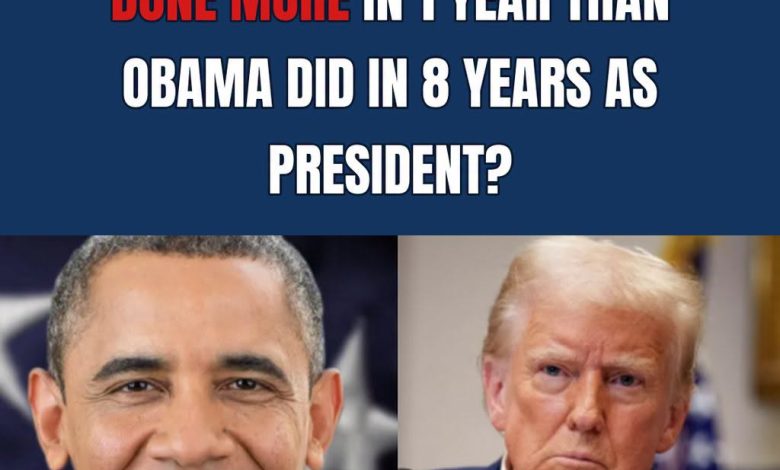
Donald Trump entered the White House promising to reverse many of Barack Obama’s policies and replace cautious, incremental government with a more aggressive “America First” agenda. During Trump’s first year, his administration moved rapidly on taxes, regulation, energy, immigration, foreign policy, and the federal judiciary.
Supporters viewed this pace as evidence that Trump accomplished in one year what previous administrations had avoided for much longer. Critics, however, argued that some positive developments—particularly in the economy—were extensions of trends that had begun before Trump took office. A fair comparison therefore requires separating measurable policy changes from broader political claims.
Tax Cuts and Economic Policy
Trump’s most significant domestic legislative achievement was the Tax Cuts and Jobs Act of 2017, which lowered the corporate tax rate and reduced taxes for many individuals and businesses.
The administration argued that these changes would encourage companies to invest, expand production, raise wages, and bring capital back to the United States. Trump also pursued an extensive deregulation campaign intended to reduce compliance costs for businesses.
Economic growth strengthened, unemployment continued to decline, and confidence among many businesses increased. Employment conditions also improved for Black and Hispanic Americans, while lower-wage workers later experienced notable wage gains.
However, the economic recovery did not begin in 2017. Trump inherited an economy that had already been expanding for several years under Obama. The stronger case for Trump is not that he created the recovery from nothing, but that his tax and regulatory policies sought to accelerate an expansion already underway.
A More Confrontational Approach Toward China
Trump broke with the previous bipartisan approach to China by openly challenging Beijing over trade deficits, intellectual-property practices, industrial subsidies, and the movement of American manufacturing overseas.
While Obama had also raised concerns about China, Trump made trade confrontation a central part of his presidency. His administration used tariffs and negotiations to pressure Beijing and to demonstrate that the United States would no longer accept existing trade arrangements without resistance.
The strategy carried risks, including higher costs for some American businesses and consumers. Nevertheless, it forced Washington to confront a problem that many voters believed political leaders had neglected for decades.
Major Changes in Middle East Policy
Trump also made highly visible changes in American policy toward Israel. His administration recognized Jerusalem as Israel’s capital and moved the U.S. Embassy there, fulfilling a promise previous presidents had delayed because of diplomatic and security concerns.
Trump later recognized Israeli sovereignty over the Golan Heights. Supporters described these decisions as overdue acknowledgments of political reality and demonstrations of support for a close American ally. Opponents warned that they weakened Washington’s ability to act as a neutral mediator in regional negotiations.
Whatever one’s view, these actions represented a clear departure from the more cautious policies followed by Obama and several earlier presidents.
Immigration and Border Enforcement
Immigration enforcement became another defining feature of Trump’s presidency. His administration tightened asylum procedures, expanded detention and deportation efforts, restricted entry from several countries, and attempted to reduce the release of migrants while their immigration cases were pending.
The administration defended its travel restrictions as national-security measures focused on countries with inadequate screening or information-sharing systems. After multiple revisions and court challenges, a version of the policy was upheld by the Supreme Court.
Supporters argued that Trump restored enforcement to a system that had become vulnerable to abuse. Critics contended that some policies were unnecessarily harsh, legally questionable, or discriminatory in their practical effects.
Claims that Obama simply “expanded catch and release” or directly caused later increases in unauthorized crossings are too simplistic. Border trends are influenced by regional instability, labor demand, enforcement policy, asylum rules, court capacity, and migration patterns across multiple administrations.
Reshaping the Federal Judiciary
One of Trump’s most lasting accomplishments was his impact on the courts. During his first year, he appointed Justice Neil Gorsuch to the Supreme Court and began filling numerous vacancies throughout the federal judiciary.
These judges were generally selected for conservative legal views, including textualism and originalism—the principle that courts should interpret laws and the Constitution according to their text and original public meaning.
For conservatives, these appointments corrected what they saw as decades of judicial activism. For liberals, they threatened established legal protections and shifted the judiciary significantly to the right. Regardless of political perspective, Trump’s judicial appointments created consequences that would extend far beyond his time in office.
Energy Production and Regulation
Trump promoted domestic oil, natural-gas, and coal production while reversing or weakening several Obama-era environmental regulations. His administration approved energy infrastructure projects, expanded access to federal lands, and emphasized what it called American “energy dominance.”
U.S. energy production increased substantially, although technological advances—particularly hydraulic fracturing and horizontal drilling—had already transformed the industry before Trump became president. The United States’ movement toward becoming a net energy exporter therefore resulted from long-term market and technological developments as well as supportive federal policies.
Trump accelerated this direction, but he did not create it alone.
The Defeat of ISIS’s Territorial Caliphate
The Islamic State lost nearly all of the territory it once controlled in Iraq and Syria during Trump’s presidency. The administration loosened some military restrictions, increased pressure on the organization, and continued working with local forces and international allies.
Trump supporters credited his more aggressive approach with completing the destruction of the ISIS territorial caliphate. Yet the military campaign had begun under Obama, and ISIS had already lost substantial territory before Trump took office.
The most accurate conclusion is that Obama built and initiated the coalition strategy, while Trump continued and intensified the campaign until the group’s territorial rule collapsed.
Healthcare and Drug Costs
Trump worked to weaken major components of the Affordable Care Act, particularly the individual mandate requiring most Americans to maintain health insurance. His administration also introduced measures intended to increase price transparency and reduce certain prescription-drug costs.
Still, Trump did not fully repeal or replace the Affordable Care Act. Although some consumers faced high premiums and limited insurance choices under the law, millions of Americans also gained coverage and protections for preexisting medical conditions.
The healthcare record was therefore mixed: Trump succeeded in dismantling parts of Obama’s system, but he did not establish a comprehensive replacement.
A Presidency Built on Speed and Disruption
The central difference between Obama and Trump was not simply the number of actions taken. It was their governing philosophy.
Obama generally favored coalition-building, institutional caution, and gradual policy development. Trump favored executive pressure, rapid deregulation, public confrontation, and visible demonstrations of American power.
To his supporters, Trump replaced hesitation with decisiveness. To his critics, he replaced stability with disruption. But even critics had to acknowledge that his first year produced major changes in tax policy, regulation, immigration enforcement, energy strategy, foreign relations, and the federal courts.
Trump’s first-year record should not be exaggerated by crediting him for every positive trend or blaming Obama for every unresolved problem. Even so, it marked a dramatic ideological break from the previous administration and established the foundations of a presidency determined to challenge Washington’s political conventions.