My father handed me this tool and said I might need it one day. I still have no idea what it’s for… and he just laughs whenever I ask.
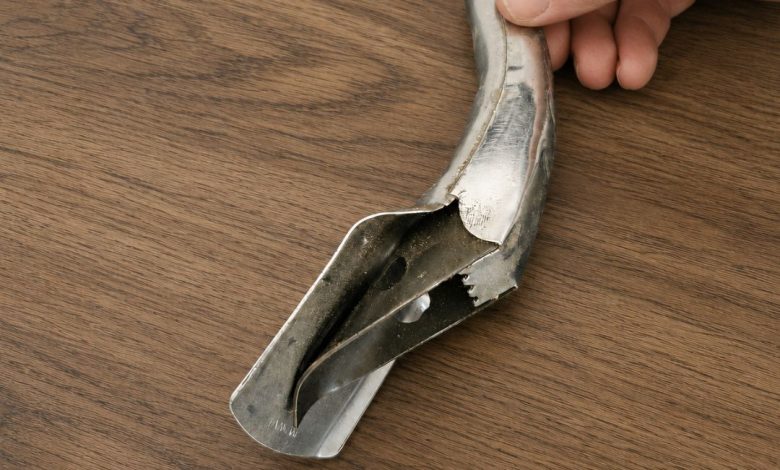
Before motor oil was commonly sold in plastic bottles with screw caps, American motorists and service stations often received it in sealed metal cans. Opening those containers neatly required a specialized device. One example was the De Luxe Can-Tapper, a reusable metal opener and pouring spout manufactured by Blackstone Manufacturing Company in the United States.
What Was It Called?
The tool was marketed as the De Luxe Can-Tapper, sometimes identified by the model number GB-2. Today, collectors may describe it as an:
- Oil-can opener
- Puncture pouring spout
- Can tapper
- Motor-oil can spout
Surviving examples are marked or advertised under the Blackstone Mfg. Co. name. Collector listings identify the tool as an original American-made gas-and-oil accessory, although they generally do not provide a confirmed production date.
When Was It Made?
The precise year in which the De Luxe Can-Tapper first appeared is not clearly documented in the available records. However, its design belongs to the era when lubricating oil was widely packaged in rigid metal cans—most likely during the middle decades of the 20th century.
These tools were especially useful before plastic oil bottles became standard. They would have been familiar equipment in gas stations, repair garages, farms, workshops, and automobile tool cabinets.
It is important not to assign an exact decade without stronger documentation. Current collector listings often label the item simply as “vintage,” and at least one listing records its creation date as unknown.
What Was Its Purpose?
The De Luxe Can-Tapper combined three jobs in one compact tool:
First, it punctured the sealed top of an oil can. Its sharp metal section cut through the lid without requiring a separate knife or punch.
Second, it locked onto the can. The tool’s gripping mechanism helped hold the attachment securely in position.
Third, it created a pouring spout. Once installed, its curved metal channel guided the oil into an automobile engine, machinery reservoir, or smaller container with less spilling.
Some versions also created or allowed an air opening, helping the oil flow more smoothly instead of leaving the can in uneven surges.
How Was It Used?
A mechanic positioned the tool against the top edge of a sealed metal oil can and pressed or clamped it downward. The pointed section pierced the lid while the surrounding metal formed a channel.
The can could then be tilted, allowing the oil to travel through the built-in spout. After the can was empty, the tapper was removed, cleaned, and reused.
Its scratched and worn appearance on surviving examples reflects the tool’s practical role. It was made as durable workshop equipment, not as a decorative household item.
Why Did It Disappear?
The can tapper became largely unnecessary when oil companies changed their packaging. Cardboard-and-metal containers and traditional steel cans were gradually replaced by plastic bottles with resealable caps and molded pouring necks.
Modern packaging made oil easier to store, open, and pour without a separate attachment. As a result, devices such as the De Luxe Can-Tapper vanished from everyday garages.
A Collectible Piece of Automotive History
Today, the Blackstone De Luxe Can-Tapper is collected as a piece of American gas-station and automotive history. It represents an era when even a routine task—adding a quart of motor oil—required a sturdy, specially engineered metal tool.
Although simple in appearance, it solved a genuine problem: puncturing, gripping, and pouring from a sealed oil can quickly and cleanly. Its design offers a small but revealing look at how American drivers and mechanics maintained vehicles before modern disposable packaging became standard.