Almost No One Can Remember What This Popular 1950’s Invention Was Used For. Can You?
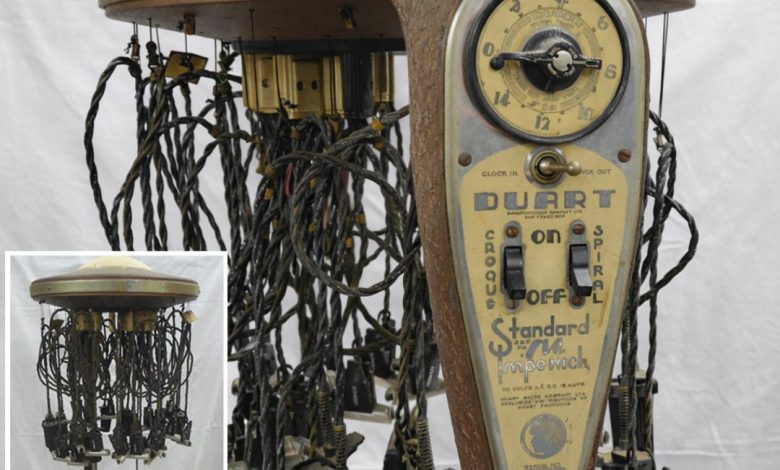
A permanent waving machine (often called an antique perm machine) is an early salon device designed to create long-lasting curls or waves by combining chemical solutions with controlled heat applied to hair wrapped around rods.
Name and Identification (From the Item Shown)
- Brand/marking visible on the control panel: DUART
- The design shows a classic multi-cord, multi-heater salon unit with numerous hanging leads used to treat multiple curl sections at once.
- The front panel includes a dial/timer and switch controls (commonly used to regulate heating time and intensity).
When It First Appeared
- Early 1900s: The first practical “permanent wave” processes emerged in the early 20th century, when salons began using heat-based systems to set curls for longer periods than typical curling irons could achieve.
- 1920s–1950s (peak use): Large electrical perm machines like the one shown became especially common in salons through the interwar years and mid-century, before compact, modern perm techniques and equipment replaced them.
Who Created the Permanent Wave Concept
- The first widely credited inventor of a practical permanent wave method is Karl Nessler (also known as Karl Nestle), a German hairdresser who demonstrated early permanent waving technology in the early 1900s.
- Companies such as Duart later manufactured and popularized commercial salon machines that refined the process, improved controls, and made perm services scalable in busy salons.
What It Was Used For
The machine’s main purpose was to produce long-lasting curls/waves by:
- Wrapping hair into sections on rods/curlers
- Applying a waving solution (chemical)
- Delivering heat through multiple heated leads to each section for a controlled time
- Allowing the hair structure to set into a new shape that could last weeks to months, depending on hair type and technique
How the Machine Worked (Simple Explanation)
Typical salon workflow looked like this:
- Section the hair into many small strands.
- Wrap each strand around a rod or curler.
- Apply a waving lotion/solution to help reshape the hair bonds.
- Attach the machine’s hanging leads/heaters to each rod.
- Use the dial/timer and switches to control heat and timing.
- After processing, the hair is neutralized/rinsed, then styled into a finished wave pattern.
Key Parts You Can Recognize on This Type of Unit
- Central control head with a large circular dial (often a timer/setting indicator)
- Switches to start/stop or select modes
- Dozens of hanging cords/leads to process many curl sections simultaneously
- A standing pole/base to position the unit above the seated client
Why It Became Popular
- It allowed salons to deliver a fashionable look—waves and curls that lasted—without daily heat styling.
- It standardized processing for multiple clients and styles, making “permanent waves” a major salon service during the height of the trend.
Collectibility and Historical Value Today
Antique perm machines are now collected as:
- Beauty industry history artifacts (salon culture, fashion trends, early electrical cosmetology)
- Industrial design pieces (dramatic, mechanical appearance and complex wiring)
- Brand memorabilia, especially when the original DUART labeling and control panel remain intact
Notable Note on Safety (Then vs. Now)
- These early systems relied heavily on heat and electricity, and older units may have aging insulation and wiring. Today, they are typically treated as display/collector pieces rather than functioning salon equipment.