Can you guess what these vintage tools were used for?
Adjustable Leather Edge Creaser (Stitch-Line Creaser): The Small Tool Behind Clean, Professional Leather Edges
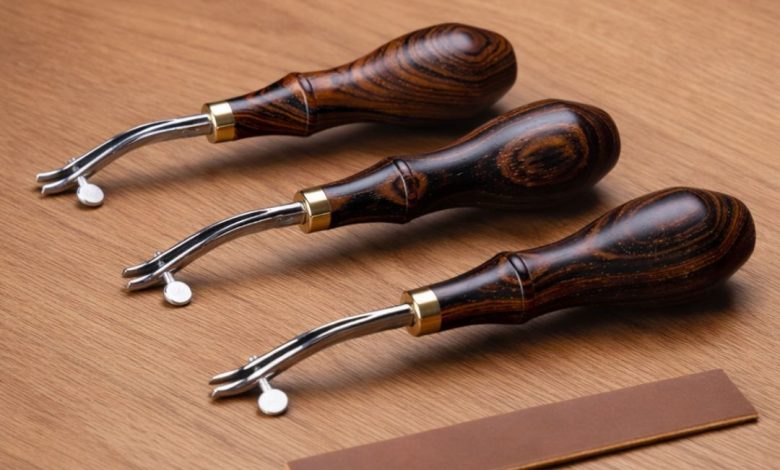
Leatherwork often looks “high-end” for one simple reason: the edges are controlled, consistent, and symmetrical. The tool shown in the image is an adjustable leather edge creaser, designed to crease the edge of leather and lay down precise guideline lines for stitching.
What Is It Called? (Common Names)
- Adjustable Leather Edge Creaser
- Stitch-Line Creaser
- Edge Creasing Tool
- Sometimes referred to as a wheel-guided edge creaser (because it uses a small guide wheel/disc)
What You’re Seeing in the Image
- A set of three creasers with wooden handles and curved metal shanks
- A small guide wheel/disc near the tip that helps maintain a consistent distance from the leather edge
- A forked creasing head that presses a clean line into the leather surface
When Did This Tool Appear?
- Creasing tools in leather trades date back centuries, used by saddlers, shoemakers, and bookbinders to mark and decorate edges.
- The adjustable, precision-guided style (with standardized parts and repeatable spacing) became widely common during the late 1800s to early 1900s, as leather production and craft tools became more standardized and widely manufactured.
- Modern versions are now popular with both professional leatherworkers and hobbyists, often made with improved steels, smoother guides, and ergonomic handles.
Who Created It?
- There is no single universally credited inventor for the adjustable edge creaser as a category.
- It is best understood as an evolution of traditional creasing irons, refined over time by toolmakers serving the saddle, shoe, and leather-goods industries.
- Different manufacturers later produced their own versions, improving adjustability, guidance, and consistency.
What Is It Used For?
- Creating crease lines along the edge
- Produces a clean, decorative groove/line parallel to the edge of a strap, wallet, belt, or bag panel.
- Marking stitch guideline lines
- Helps position stitching so it stays straight, evenly spaced from the edge, and visually balanced.
- Improving folding and edge control
- A crease can act like a “track,” helping leather fold neatly and predictably.
- Professional finishing
- Adds the crisp, intentional detail seen in luxury leather goods.
How It Works (Simple Explanation)
- The leatherworker sets the tool so the guide wheel rides the edge of the leather.
- The creasing head presses into the surface to form a consistent line.
- Many leatherworkers apply the crease after lightly dampening leather (or with controlled heat, depending on technique and leather type) to make the line cleaner and longer-lasting.
Why “Adjustable” Matters
- Different projects require different spacing:
- Small goods (cardholders, watch straps): tighter margin
- Belts and bags: wider margin for stronger visual framing
- Adjustability allows one tool to handle multiple stitch-line offsets without switching tools.
Where It’s Commonly Used
- Saddlery and harness work
- Shoemaking
- Wallets, belts, bags, and straps
- Bookbinding and leather covers
Tips for Best Results
- Keep pressure consistent to avoid wavy lines.
- Run the guide wheel firmly against the edge so the offset stays uniform.
- Test spacing on scrap first—small changes can dramatically change the look of a finished edge.