Do you know what this old tool was used for? Back in the day, many of us were familiar with it.
What is it?
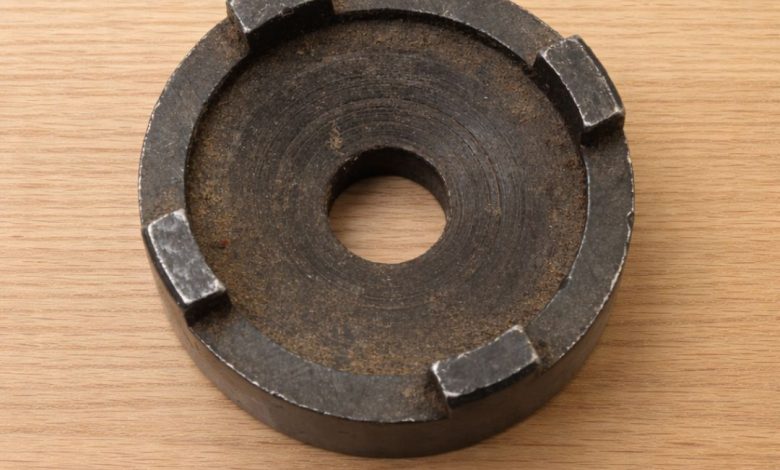
The SUNTOUR 888 is a specialized bicycle drivetrain service tool designed to remove (and install) certain threaded freewheels, lockrings, or hub-related retaining rings that use a 4-notch interface. The tool’s four raised tabs bite into matching notches on the component so it can be turned safely without slipping.
What you’re seeing in the image (key design details)
- Circular hardened-steel body with visible aging and wear
- Four raised drive lugs spaced evenly around the outer edge (the “4-notch” engagement)
- Center bore hole that allows alignment over an axle area or lets a fastener/shaft pass through, depending on the setup
- Built for high torque, because stuck freewheels/lockrings can be extremely tight
Name and identification
- Name: SUNTOUR 888 hub/freewheel/cassette removal tool
- Brand: SUNTOUR (Japan)
- Type: 4-notch removal tool (workshop service tool)
When did it appear? (time period of origin)
This style of dedicated remover became common during the freewheel-heavy era of cycling, especially from the late 1970s through the 1980s, when brands produced model-specific tools for their hubs/freewheels and service networks. The SUNTOUR 888 is typically associated with that classic Japanese road and touring component period.
Who created it?
- Created by: SUNTOUR (Japan), a major Japanese component maker widely known for precision drivetrain parts in the 1970s–1980s.
- Developed by: SUNTOUR’s engineering and service-tool program to support mechanics with the correct interfaces for SUNTOUR-compatible systems.
What is it used for? (main purpose)
- Primary function: Engage a 4-notch ring so a mechanic can break loose, remove, or tighten the matching freewheel/lockring/retaining ring without damaging the component.
- Why it matters: Without the correct tool, mechanics risk rounded notches, slipped tools, damaged hubs, and inconsistent torque.
How it’s typically used (easy steps)
- Confirm compatibility: Ensure the component you’re removing has a matching 4-notch pattern and that the tool seats fully.
- Seat the tool firmly: Press the four lugs into the notches so there is full contact.
- Apply controlled torque: Turn using a suitable method (commonly a wrench/handle setup or a bench/holding method, depending on the workshop practice).
- Remove the part: Once loosened, continue turning until the ring/freewheel/retainer comes free.
- Inspect notches and threads: Check for wear, then reinstall/replace parts as needed.
Why collectors and mechanics still value it
- Model-specific authenticity: Tools like the 888 reflect the era when brands built dedicated service ecosystems.
- Durability: Typically made from toughened steel to survive repeated high-torque use.
- Practical utility: Still useful for restoring and maintaining vintage SUNTOUR-era wheels and drivetrains.