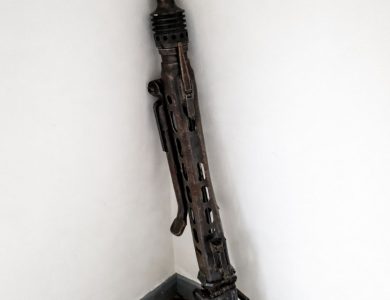
Found this at a yard sale but I have no idea what it is. Thoughts?
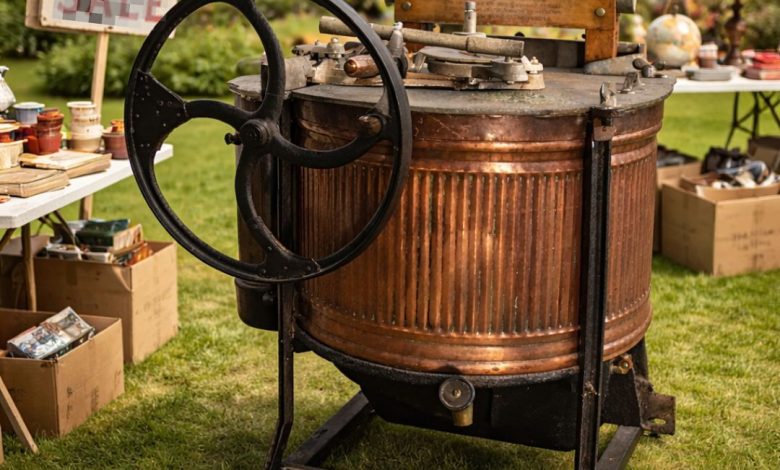
Name / What It Is
- Name: Coal-Heated Washing Machine (Dutch: “Wasmachine met kolenverwarming”)
- Type: Early mechanical washer with an internal heating method
- Estimated period: 1925–1930
- Key materials: Copper tub with a brass rim
- What can be said confidently: it reflects common early 20th-century design, when home laundering relied on manual mechanics and non-electric heat.
Why It Was Made (Purpose)
- Main use: Washing clothes by agitating them in hot soapy water (suds).
- Problem it solved (for its time): heating wash water before reliable, powerful, and safe electric heating elements were widely available.
How It Worked
- Heating the Water
- Under the tub sits a small coal stove/heater that could warm the water inside the machine.
- This was considered primitive and inefficient, but it provided a workable way to heat suds in an era of limited electric heating.
- Agitation Inside the Tub
- Inside the tub is a wooden agitator (described as a “houten waskruis”—a wooden cross-shaped washing device).
- Originally, the agitator was driven by hand power using the large side wheel.
- Preventing Clothes From Tangling
- To keep laundry from twisting into a tight knot, the machine used a mechanism that made the agitator move alternately left and right rather than continuously in one direction.
- Later Upgrade: Electric Motor
- The description notes that an electric motor was added later, meaning the machine began as a hand-cranked washer and was modernized afterward.
Notable Features Visible in the Image
- Large black flywheel on the side for manual cranking
- Copper cylindrical tub with vertical ribbing and visible age/patina
- Mechanical linkages above the tub that translate wheel motion to the agitator
- Sturdy metal frame legs supporting the unit
- Top assembly with fittings and clamps, showing an industrial, utilitarian build
Limitations and Practical Drawbacks
- Inefficient heating: coal heat was slow and difficult to control precisely
- Awkward workflow: stoking coal while washing in the same unit was not convenient
- More labor-intensive: early operation depended on manual power until the later motor addition
Why This Machine Matters
- It captures a transition period in household technology:
- From manual, mechanical washing
- To electrified convenience, as electric motors and safer heating systems became more common
- The copper and brass construction also reflects the durability and material choices typical of higher-quality appliances of the era.