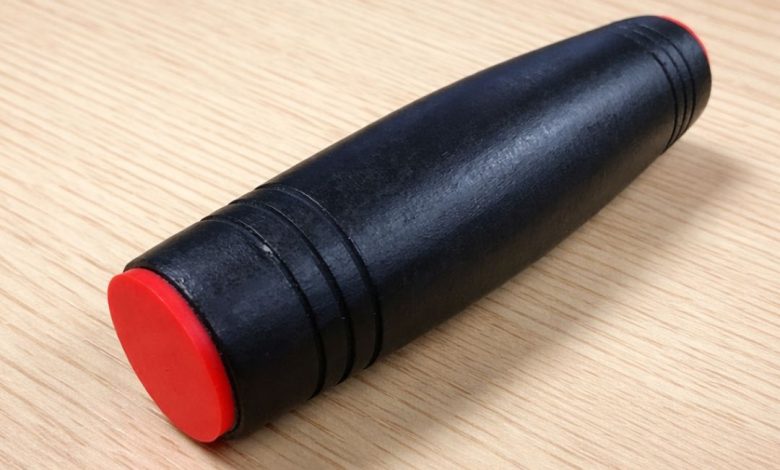
It’s 3 inches long, appears to be nylon body with red rubbery glued-in ends. It’s light, hollow, makes no noise when shaken.
1) Name and What You’re Looking At
The item in the images is commonly sold as a Mokuru fidget stick (also marketed as a Flip Stick Desk Toy).
- Shape: A short, barrel-like convex cylinder with flat ends
- Key design detail: Rubber/silicone end caps (often red) that help it grip, rebound, and “stand up” after flipping
- Body material (classic version): Beech wood is widely associated with the original-style Mokuru; many modern versions are also made in plastic or other materials
2) When It First Appeared
- Created concept (early development): 2010 (often credited to Japanese designer Masakazu Node, with years of refinement afterward)
- Became widely known internationally: 2017, when it spread more broadly through online buzz and crowdfunding-era distribution
3) Main Purpose and Benefits
Mokuru is designed to be a desk-friendly fidget and skill toy that combines relaxation with coordination training.
- Stress relief and focus: repetitive flipping can be calming and helps some people stay engaged while studying or working
- Dexterity training: improves fine motor control, hand–eye coordination, and timing
- Creativity: encourages creating new sequences, patterns, and “combos”
- Social play: easy to pass around and challenge friends with trick progressions
4) How It Works (Simple Physics, Smart Materials)
Its “magic” comes from a few practical design choices:
- Weighted, rounded body: helps it roll smoothly and rotate predictably
- High-grip rubber ends: reduce slipping, add bounce, and help it recover upright
- Grooved rings near the ends: provide extra grip and finger control during catches and spins
5) Core Moves and Trick Ideas (from the product description)
Below are common move categories frequently taught to beginners:
- Flip
- Use one finger to tip the stick so it flips from left to right (or right to left).
- Goal: flip and catch cleanly.
- Square (4-point pattern)
- Flip with four contact points to trace a square-like rhythm on the surface.
- Triangle (3-point pattern)
- Flip with three points to create a triangle-style pattern.
- Catch and Hold
- After flipping, catch it and stabilize it in your hand.
- Flip & “Kiss” (two-stick interaction)
- Use one stick to nudge/trigger the other, flipping it side-to-side or up-and-down.
- Big Square (two sticks)
- Use two sticks and both hands to form a larger square pattern.
- Air Trapeze
- Flip with one finger, catch on the hand, add a squeeze/stop, then rotate and set it upright.
- Twins (two sticks, one hand)
- Move two sticks in tandem using one hand—timing is the challenge.
- Five-Movement / Multi-stick Balance Challenge
- Using multiple sticks (e.g., five), attempt tandem motion and balancing—typically considered an advanced skill test.
6) Where People Use It
- Office desk / study table: quick breaks without needing much space
- Classroom downtime: silent, small, and portable (when used respectfully)
- Skill practice sessions: like yo-yo or pen-spinning, but easier to start
7) Quick Buyer Notes (Practical Expectations)
- If you want smoother control, look for:
- Grippy end caps
- Solid build (wood or dense plastic)
- Consistent weight balance
- For learning:
- Start with single-stick flips, then move to pattern flips, then two-stick routines.