Jackson’s Dissent Raises a Larger Question About Title IX and Women’s Sports
On June 30, 2026, the Supreme Court ruled that states may reserve girls’ and women’s school athletic teams for biological females. In West Virginia v. B.P.J. and Little v. Hecox, the Court held that the laws challenged in West Virginia and Idaho did not violate Title IX or the Equal Protection Clause. Justice Brett Kavanaugh wrote the majority opinion, joined by five other justices.
The ruling addressed a limited but consequential question: May states determine eligibility for female athletic teams according to biological sex? The Court’s answer was yes. It did not hold that every state must adopt such a policy, leaving states that permit transgender athletes to compete according to gender identity free to defend their own rules in future litigation.
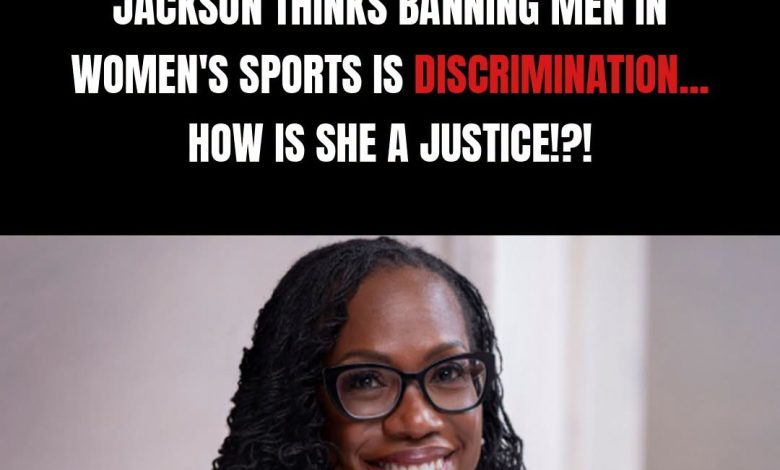
Justice Ketanji Brown Jackson joined much of Justice Sonia Sotomayor’s dissent and also wrote separately. Some online commentary has summarized Jackson’s position as a simple claim that excluding transgender athletes from female teams is unlawful discrimination. That description leaves out a crucial part of her opinion.
Jackson agreed that the transgender athlete’s Title IX claim failed under the legal framework presented in the case. She acknowledged that federal regulations implementing Title IX permit schools to separate athletic teams by biological sex. In her terminology, that separation constitutes sex-based discrimination in a descriptive sense, but it is a form of distinction that the law currently permits in athletics.
Her disagreement with the majority went further. Jackson argued that the Court should not have broadly declared that the word “sex” in Title IX can refer only to biological sex, even within the sports context. She maintained that Title IX may also protect people against certain forms of gender stereotyping and discrimination connected to gender identity.
That distinction may sound technical, but it carries major consequences.
A government classification can be discriminatory without being legally prohibited. Schools discriminate by age when they create grade levels and by athletic ability when they select varsity teams. Likewise, separating male and female sports teams treats athletes differently according to sex, but Congress and federal regulators have historically permitted that distinction to preserve equal athletic opportunities.
The strongest criticism of Jackson’s reasoning, therefore, is not that she denied the existing legality of sex-separated sports. She did not. The concern is that her broader interpretation of Title IX could make those categories less legally stable in future cases. Courts could increasingly be asked to determine whether individual athletes should receive exceptions based on gender identity, medical treatment or their particular physical development.
The majority rejected that individualized approach. It emphasized that sports differ from ordinary classrooms and workplaces because strength, speed, endurance, size and other physical characteristics can directly determine competitive results and safety. It also said the effects of puberty blockers and hormone treatment remain subjects of medical and scientific disagreement, making judges poorly suited to conduct athlete-by-athlete physiological evaluations.
For defenders of women’s sports, administrable rules matter. Athletic competition is often zero-sum: one athlete receives the roster position, medal, record or scholarship that another athlete does not. A category whose boundaries depend on complicated medical assessments could become inconsistent, expensive and difficult for schools to enforce fairly.
Title IX expanded opportunities for female athletes because it recognized that equality sometimes requires separate categories—not because it treated male and female athletic performance as interchangeable. According to the Court, participation by high-school girls grew from roughly 300,000 before Title IX to millions today. The majority concluded that states may continue protecting those opportunities through eligibility rules based on biological sex.
The interests of transgender students should not be dismissed. They also seek teamwork, belonging and the opportunity to compete. The majority expressly stated that transgender athletes deserve respect and should not be ostracized or vilified. But compassion alone does not answer how competitive categories should be structured. Protecting personal dignity and preserving female athletic divisions are separate objectives, and policymakers may pursue accommodations without eliminating sex-based eligibility standards.
The Court ultimately answered a narrow legal question in favor of the states. Jackson’s dissent did not declare every restriction illegal, but it offered a broader vision of Title IX that could support future challenges to sex-based rules.
Americans can disagree about that interpretation. What should not be lost amid political slogans is the central issue: Can Title IX continue protecting women’s athletic opportunities if the meaning of sex becomes uncertain?
For those who believe female competition requires objective and consistently enforceable boundaries, the Court’s ruling represents a defense of fairness, legal clarity and judicial restraint. The broader cultural debate will continue, but it should begin with an accurate account of what the justices actually decided—and what they did not.