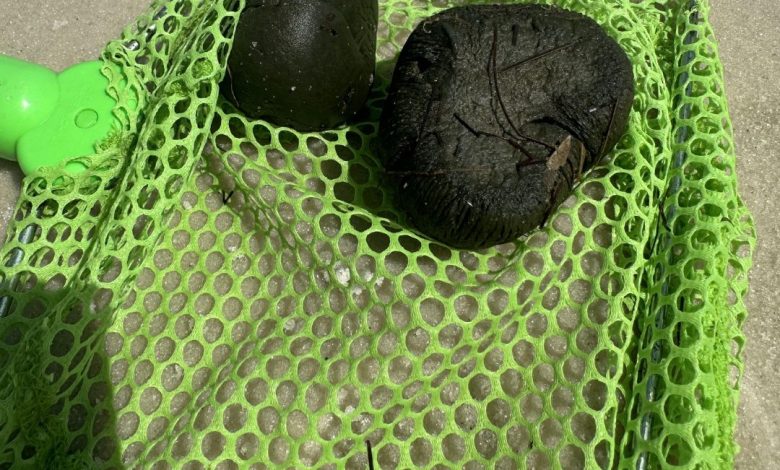
My kids are calling these “sea turds,” since they are round, soft/spongey and dark green but what are they really?
A Common Coastal Curiosity
If you’ve spent time around Pensacola Bay with kids, you may have heard someone proudly announce they found a “sea turd.” The name is funny, but the object is usually something far more ordinary (and surprisingly interesting): a mudball shaped by the bay’s moving water.
You’ll often spot these rounded clumps near:
- Sandy banks
- Grassy marsh edges
- Shallow bayside shorelines
Important point: These are typically not manmade and not marine animal droppings, despite the nickname.
What Mudballs Actually Are
In simple terms, mudballs are compact lumps of soft sediment (mud and fine clay) that get rolled and shaped over time. Many are darker in color because local sediment can be organic-rich, which can make them look dark green to nearly black.

How Mud Becomes a Ball
Mudballs form through a straightforward natural process:
- Soft mud banks sit underwater, often just out of sight.
- Small chunks break off due to currents, waves, or disturbance along the shoreline.
- The loose lump tumbles and rolls along the bottom as water moves it.
- Sand and water smooth and round it, gradually shaping it into a ball-like form.
This is similar to how river stones or sea glass become smoother the longer they move through water.
Is It “Just Mud,” or Something Worse?
In most cases, it’s just normal sediment—soft, harmless, and often smell-free. But sometimes the color and texture can make people wonder if it includes something like tar, oil, or other residue.
A practical safety check:
- If it smells strange, feels unusually sticky/gummy, or leaves residue, don’t keep it.
- Toss it and wash your hands afterward.
A Coastal Kid’s Keepsake
For many families near the Gulf Coast, finding these mudballs is a small tradition—weird, funny, and memorable. They’re the kind of discovery that sparks curiosity and leads to simple questions like:
- “Where did this come from?”
- “Why is it so smooth?”
- “What’s under the water here?”
Mudballs and Coastal Memory
Not every beach find belongs in a display case, but some belong in family stories. Whether it’s a shell, a sand dollar, or a squishy mudball nicknamed a “sea turd,” these small discoveries are part of what makes coastal days feel unforgettable.