Peeled Hard-Boiled Eggs in the Fridge: Convenience Habit or Food Safety Risk?
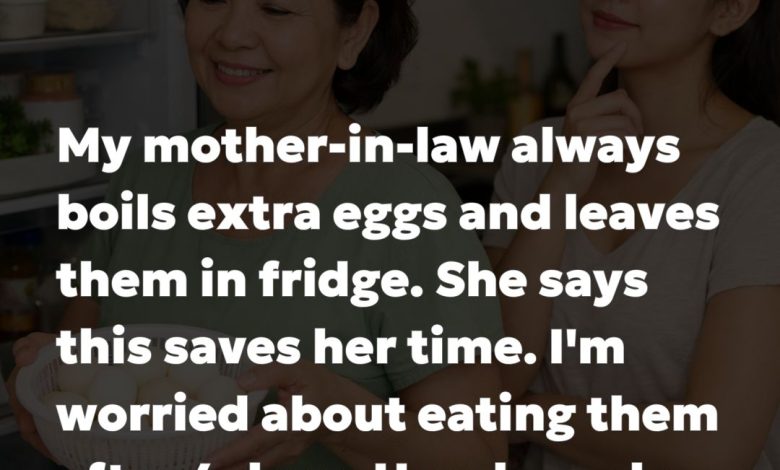
Clara stood in front of the refrigerator far longer than she meant to, unable to look away from what she saw on the second shelf: a row of hard-boiled eggs, already peeled, neatly arranged, and covered only by a plastic lid.
It wasn’t the eggs themselves that unsettled her. It was what they represented.
Growing up, Clara had learned a very strict rhythm around food. Her mother treated the kitchen like a place where mistakes could have consequences. She checked labels and expiration dates, sniffed containers, and never allowed leftovers to sit out. In Clara’s childhood home, food was either eaten immediately or thrown away. There was no comfortable “in-between.”
Now Clara was living in a different system entirely.
A Kitchen That Didn’t Match Clara’s Rules
Her mother-in-law, Ruth, didn’t cook only when people were hungry. She cooked so hunger wouldn’t become urgent.
In Ruth’s house, the refrigerator wasn’t a chaotic storage box. It was a plan.
Clara began noticing patterns:
- Soups and stews prepared ahead and stored neatly
- Cooked grains kept ready for quick meals
- Fruit washed, cut, and portioned in advance
- Eggs boiled “just in case,” ready to eat any time
To Clara, it felt risky. To Ruth, it felt practical.
That first day, Clara quietly closed the fridge and decided not to touch the eggs. But the image followed her around, like her mind was trying to solve a small mystery.
The Question Clara Was Afraid to Ask
Later that afternoon, Clara found Ruth outside in the garden. Ruth wore an old shirt, moved slowly, and worked as if there was no reason to rush.
Clara watched her for a moment, then asked—carefully—about the eggs.
Ruth didn’t act defensive. She simply smiled and explained:
- She boiled eggs every few days.
- It saved time, especially in the mornings.
- If someone was hungry, food was already ready.
- That was the whole reason.
No speech about rules. No lecture on safety. Just a habit she found useful.
And strangely, that calmness made Clara think even more.
What Clara Realized After Paying Attention
Over the next few days, Clara started observing Ruth’s kitchen more closely—and what she saw changed everything.
It turned out nothing in Ruth’s fridge was random.
Clara noticed key details:
- Containers were labeled with dates
- Leftovers were rotated instead of forgotten
- Food was stored in an organized, consistent way
- Ruth had a routine she had followed for years
The fridge wasn’t careless. It was controlled.
Clara began to understand a bigger idea: Ruth wasn’t ignoring food safety—she was managing food intentionally. Ruth’s approach wasn’t “eat it now or lose it.” It was “prepare steadily so life stays easier.”
In Clara’s words, Ruth didn’t cook around hunger—she cooked so hunger wouldn’t be an emergency.
Two Different Backgrounds, Two Different Food Mindsets
Clara reflected on why this felt so unfamiliar.
In her childhood, food had emotional pressure attached to it:
- Waste felt like failure
- Leftovers felt suspicious
- Preparing too much felt unnecessary
In Ruth’s kitchen, food felt stable. It didn’t create stress. It reduced it.
It wasn’t that one approach was right and the other was wrong. They were built from different experiences and different definitions of “being careful.”
The Quiet Change Clara Didn’t Plan
Without making a big decision, Clara started copying small parts of Ruth’s routine. Not because she was trying to change herself, but because the habits made everyday life smoother.
She began doing things like:
- Washing vegetables right after bringing them home
- Cooking a little extra rice instead of exactly enough
- Thinking one meal ahead instead of solving everything at once
- Keeping the kitchen ready for tomorrow, not just for today
Nothing dramatic happened overnight. But Clara noticed one clear difference: her evenings felt less rushed.
The Moment It Finally Made Sense
One night, Clara and Ruth sat at the table together, peeling eggs for dinner. They talked about ordinary things:
- the weather
- errands
- someone they both knew
And Clara realized something important: she wasn’t uneasy anymore.
Not about the eggs. Not about the fridge. Not about doing things differently than she was raised to do.
She finally said, quietly, “I think I understand now.”
Ruth smiled and answered with the simplest explanation possible:
“It helps. That’s all.”
The Point Was Never Just the Eggs
Later, when Clara put the eggs back into the fridge, she looked at them differently.
They were still just eggs.
But now she understood what they symbolized:
- preparedness without panic
- routine instead of urgency
- a household built to feel steady
And that was the real shift.
Clara didn’t adopt Ruth’s system because she was forced to. She adopted it because she saw how it worked—not only for food, but for life.
In the end, the eggs weren’t the lesson.
The lesson was that “different” doesn’t automatically mean “unsafe.” Sometimes it simply means someone found a way to make daily life easier—and kept doing it.