Rosie O’Donnell’s Latest Trump Claim Reveals a Feud That Refuses to End
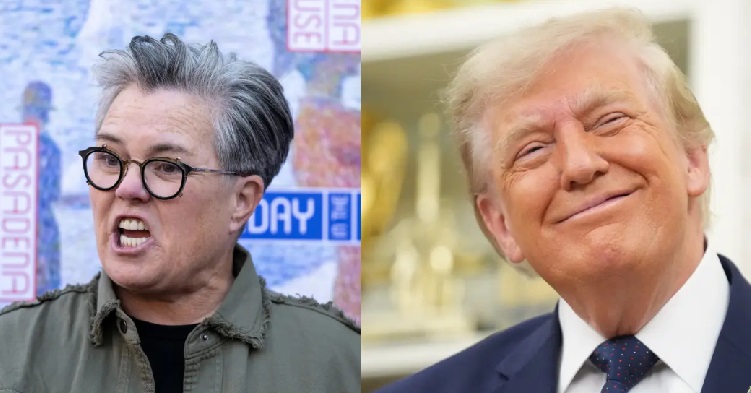
Nearly two decades after their public feud began, Rosie O’Donnell is once again placing President Donald Trump at the center of her commentary—this time by suggesting that her presence triggers a “PTSD response” in him.
During an interview with Variety, O’Donnell reportedly connected their long-running conflict to their shared New York backgrounds. She portrayed herself as the kind of outspoken schoolgirl who would have challenged a wealthy and overconfident classmate like Trump. She later expanded on that comparison during an appearance on Sophia Bush’s podcast.
O’Donnell claimed that she reminds Trump of childhood failures and rejection. However, the statement is personal speculation rather than a medical assessment, and it offers no evidence that the president has post-traumatic stress disorder.
That distinction matters. PTSD is a serious mental health condition affecting veterans, crime victims, disaster survivors and others who have experienced severe trauma. Using the term as a rhetorical weapon in a celebrity feud risks minimizing the experiences of people who genuinely live with the condition.
A Conflict Dating Back to 2006
The public battle between Trump and O’Donnell began in 2006, when she criticized his handling of controversy surrounding a Miss USA pageant winner while appearing on The View. Trump responded with a series of personal insults, and the dispute quickly became national entertainment news.
What might have ended as a brief celebrity argument instead developed into one of America’s longest-running pop-culture political feuds.
Over the years, O’Donnell has repeatedly criticized Trump through interviews, television appearances and social media. Trump has also attacked her publicly on numerous occasions. Yet O’Donnell’s latest remarks raise an obvious question: Who is still being emotionally controlled by this conflict?
Trump has returned to the White House and is occupied with major national and international issues. O’Donnell, meanwhile, continues to revisit an argument that began during the George W. Bush administration.
Social Media Users Question Her Claim
Online reactions were predictably divided, but many commenters argued that O’Donnell’s statement sounded self-important. Critics accused her of imagining that she occupies a much larger place in Trump’s thoughts than she probably does.
The familiar phrase “Trump lives rent-free in her head” appeared throughout the discussion. Others described her comments as narcissistic or disconnected from reality.
Those responses may be harsh, but they highlight a central weakness in O’Donnell’s argument. There is no public evidence that Trump experiences a psychological reaction merely because she exists. Her theory may reveal more about how she interprets their relationship than about Trump’s actual state of mind.
Celebrity Activism or a Search for Relevance?
O’Donnell’s criticism of Trump is not unusual in Hollywood. Many entertainers have transformed their public platforms into vehicles for political activism. They are entitled to do so, just as Americans are entitled to question whether celebrity status provides any special political insight.
The problem arises when personal resentment is presented as psychological expertise.
O’Donnell is not Trump’s doctor, and a decades-old exchange of insults does not qualify her to diagnose him. Her latest comments therefore resemble political theater more than serious analysis.
She has also spoken openly about how frequently she discusses Trump, reportedly acknowledging the difficulty of stepping away from posting about him. That admission complicates her claim that she is the person exerting psychological control over the president.
America Has More Important Concerns
The country faces serious debates over border security, inflation, economic growth, public safety, foreign policy and government accountability. Americans may reasonably disagree about Trump’s handling of those issues, but those arguments should focus on policies, evidence and measurable results.
A celebrity’s unsupported theory about the president’s childhood psychology contributes little to that discussion.
O’Donnell may view herself as a fearless opponent who uniquely unsettles Trump. To many Americans, however, the continuing feud looks less like political resistance and more like a personal grievance preserved long after its expiration date.
After nearly 20 years, the spectacle has become repetitive. Trump and O’Donnell exchanged insults, attracted headlines and moved deeper into opposing political camps. None of that establishes a diagnosis, proves a trauma response or advances a meaningful national debate.
The larger lesson is simple: long-held grudges often reveal more about the person maintaining them than the person they are directed against.
Rosie O’Donnell may believe she remains one of Donald Trump’s greatest psychological adversaries. But her continued need to revive their feud suggests that she—not Trump—may be the one who has never truly moved on.