Trump Draws a Hard Line After Violent Anti-ICE Clashes in New Jersey
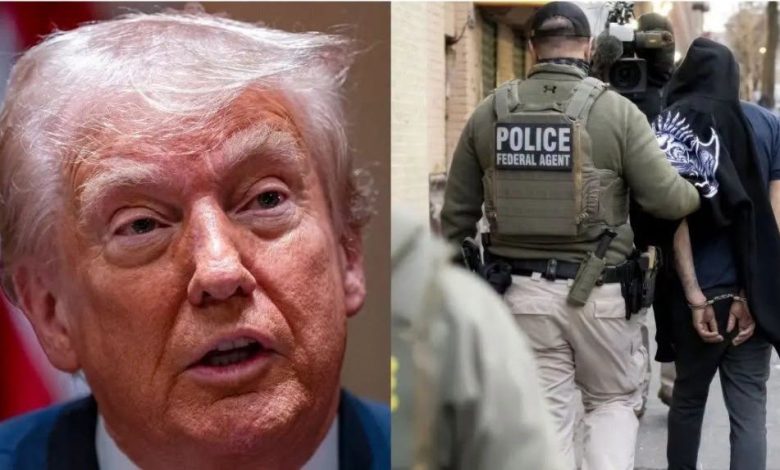
President Donald Trump is once again forcing Washington to confront a question too many politicians would rather avoid: What happens when protest crosses the line into intimidation, violence, and open obstruction of federal law enforcement?
The answer should not depend on party affiliation. Peaceful protest is protected. Assaulting officers, blocking official operations, throwing objects, setting fires, or trying to paralyze a federal facility is not.
That distinction matters after the escalating unrest outside Delaney Hall in Newark, New Jersey, where demonstrations against ICE operations have led to repeated clashes with law enforcement. More than 80 people have reportedly been arrested during the series of protests, while authorities have described incidents involving projectiles, barricades, and confrontations with officers.
Trump has argued that some of the protesters are not ordinary citizens expressing concern, but organized agitators being used to manufacture chaos around immigration enforcement. Fox News reported that Trump called the Delaney Hall protesters “fake” and “paid for” during a Cabinet meeting.
That claim is politically explosive. It also requires evidence. Some reporting has noted that Trump made the “paid protesters” claim without publicly presenting proof. Still, the broader question he raised is legitimate: If outside groups are funding or coordinating efforts to provoke violence against federal officers, the public deserves to know who is behind it.
There is no constitutional right to attack ICE agents. There is no First Amendment shield for violence. And there is no serious definition of “democracy” that allows mobs to override laws passed by Congress simply because activists dislike immigration enforcement.
Federal officers are tasked with enforcing immigration statutes. That job is controversial, difficult, and often dangerous. But in a functioning republic, policy disputes are settled through elections, legislation, courts, and lawful advocacy — not by turning detention facilities into political battlegrounds.
Reports from the scene show why the issue has become a national flashpoint. The Associated Press reported that some demonstrators used makeshift shields and barricades, attempted to block vehicles, and threw objects toward ICE officers. DHS said several demonstrators were arrested for assaulting law enforcement officers. ABC News also reported allegations from New Jersey officials that some protesters engaged in dangerous actions, including throwing projectiles and using barriers as weapons.
At the same time, the situation is not one-dimensional. Activists and Democratic lawmakers have claimed that detainees inside Delaney Hall faced poor conditions, including inadequate medical care and unhealthy food. DHS and the private operator have denied allegations of abuse or poor conditions.
But even if people believe conditions inside the facility deserve investigation, that does not justify violence outside it. Oversight is lawful. Rioting is not. Accountability is lawful. Assault is not. Protest is lawful. Obstruction and intimidation are not.
That is where Trump’s message connects with many Americans: law enforcement cannot be allowed to retreat every time a political crowd grows loud enough or aggressive enough. If ICE officers are enforcing federal law, then elected leaders have a duty to protect them from attacks — not excuse the attacks because they serve a fashionable political cause.
The most important next step is not rhetoric. It is investigation.
If prosecutors can prove that individuals assaulted officers, they should face serious charges. If investigators uncover coordinated funding meant to incite violence or disrupt federal immigration operations, that network should be exposed. And if political leaders encouraged disorder while pretending it was peaceful dissent, voters should hold them accountable.
America can debate immigration policy. America can argue over detention conditions. America can demand transparency from federal agencies. But America cannot survive a standard where federal law is enforced only when activists permit it.
The rule of law must apply in Newark, at the border, in Washington, and everywhere in between.