Washington Clash Over SAVE America Act Puts Election Security and ICE Enforcement Back at Center Stage
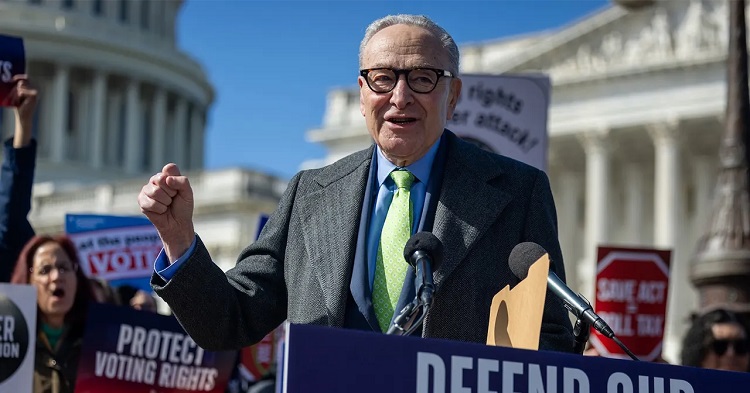
A new political fight in Washington is intensifying as Republicans push for tougher federal election safeguards while Democrats warn that the proposal could make voting harder for millions of eligible Americans.
At the center of the debate is the SAVE America Act, a Trump-backed election bill that would require documentary proof of U.S. citizenship for voter registration and government-issued photo identification to cast a ballot in federal elections. The House passed the measure in February 2026 by a narrow 218–213 vote, but the bill faces a much tougher road in the Senate.
For Republicans, the argument is simple: American elections should be decided only by American citizens, and voters should be required to prove who they are before participating in federal elections. Supporters say these requirements are basic protections, not extreme restrictions.
They argue that photo ID is already required in many parts of daily life, including travel, banking, employment paperwork, and government services. From that perspective, requiring identification at the ballot box is presented as a matter of public trust.
Democrats see the bill very differently.
Sen. Cory Booker and other Democratic critics have described the SAVE America Act as a voter suppression measure, arguing that proof-of-citizenship requirements could create serious barriers for eligible voters who do not have easy access to documents such as passports, birth certificates, naturalization records, or updated name-change paperwork. PolitiFact reported that the bill would not automatically block married women who changed their names from voting, but it could add extra documentation hurdles for them.
That concern has become one of the Democrats’ central arguments: even if the bill is written as an election-security measure, they say its practical effect could be to discourage or delay lawful voters.
Republicans counter that this objection raises an obvious question: if citizenship is already required to vote in federal elections, why should proving citizenship be treated as unreasonable?
The dispute has widened beyond voter ID and citizenship documents. It is now tied to another heated issue: Immigration and Customs Enforcement, or ICE.
House Democratic Leader Hakeem Jeffries and other Democrats have pushed for limits on federal immigration enforcement as part of the broader fight over Department of Homeland Security funding. Democrats have demanded restrictions on enforcement activity in so-called sensitive locations, including schools, churches, medical facilities, courts, and polling places.
Republicans argue that keeping ICE away from polling places could send the wrong signal at a time when confidence in elections is already fragile. To them, federal law enforcement should not be treated as a threat when the goal is to prevent illegal voting and foreign interference.
Democrats respond that the issue is not protecting unlawful voters, but preventing voter intimidation. They warn that visible immigration enforcement near polling places could discourage lawful citizens, especially naturalized citizens or people from immigrant communities, from voting.
The Department of Homeland Security has attempted to lower tensions. According to the Associated Press, a DHS official told state election officials that federal immigration agents would not be stationed at polling places during the midterm elections.
Still, the political fight remains unresolved.
For conservatives, the SAVE America Act represents a long-overdue correction to an election system they believe has become too loose, too vulnerable, and too dependent on trust without verification. They see photo ID, citizenship verification, and stronger voter-roll checks as essential tools for restoring confidence.
For Democrats and voting-rights groups, the same provisions look like a national restriction that could hit lawful voters who lack paperwork, live far from government offices, or face bureaucratic complications.
That is the core divide: Republicans are framing the issue as election integrity; Democrats are framing it as voting access.
As the 2026 elections approach, this fight is likely to grow louder. The question now is whether Congress can find a balance between two principles that both sides claim to defend: protecting the ballot from fraud and protecting eligible citizens from being shut out of the process.
One thing is already clear: the SAVE America Act has become more than a voting bill. It is now a national test of how much verification Americans believe democracy requires — and how much restriction they are willing to accept in the name of security.