You have 60 seconds to think of an answer to this tricky equation from a 1992 test.
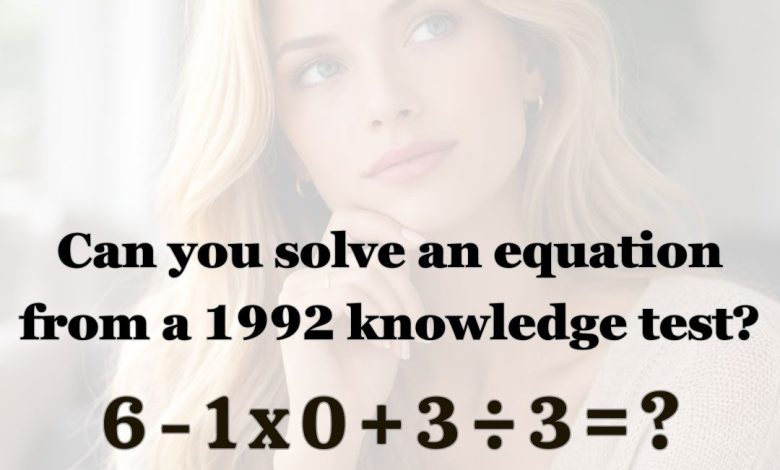
A simple-looking math question from a 1992 knowledge test has resurfaced and sparked discussion online. At first glance, the equation appears easy, but many people arrive at different answers because they overlook basic mathematical rules.
The Equation in Question
- 6 − 1 × 0 + 3 ÷ 3 = ?
This expression tests whether the solver correctly applies the order of operations, a foundational rule taught in mathematics.
Understanding the Order of Operations
To solve the equation correctly, calculations must follow this standard sequence:
- Multiplication and division first
- Addition and subtraction last
- Work from left to right when operations are at the same level
This rule is often remembered by the acronym PEMDAS:
- Parentheses
- Exponents
- Multiplication
- Division
- Addition
- Subtraction
Step-by-Step Solution
- 1 × 0 = 0
- 3 ÷ 3 = 1
- Substitute back into the equation:
- 6 − 0 + 1
- Perform addition and subtraction from left to right:
- 6 − 0 = 6
- 6 + 1 = 7
Final Answer
- The correct result is: 7
Why This Question Is Tricky
- Many people mistakenly calculate the equation from left to right without prioritizing multiplication and division
- Others underestimate how simple operations with zero and division can affect the final result
- The problem highlights how easily basic rules can be forgotten over time
Why This Question Still Matters
- Reinforces the importance of fundamental math principles
- Demonstrates how small details change outcomes
- Shows why classic test questions remain useful for critical thinking