Anti-Trump Hitler Comparisons Have Turned Political Debate Into Reckless Theater
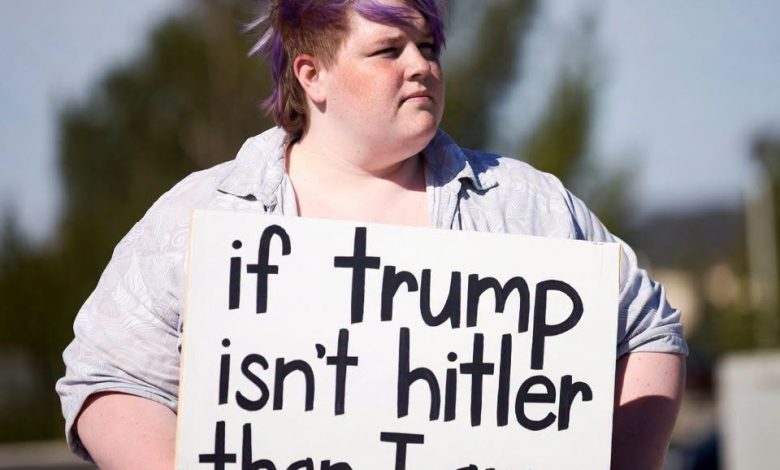
A protester holding a handmade sign recently offered a revealing example of how overheated America’s political rhetoric has become. The message essentially declared that if Donald Trump is not comparable to Adolf Hitler, then the sign holder must be a fool.
The placard was presumably intended as an attack on Trump. Instead, it exposed a deeper problem: some political activists have become so committed to extreme historical comparisons that they treat reconsideration as more humiliating than being wrong.
For years, Trump’s harshest opponents have compared him to dictators, fascists, and even the Nazi leader responsible for one of history’s worst genocides. Such accusations may attract attention on social media, but repetition does not make them accurate.
Comparing a modern American president to Hitler is not serious historical analysis. It reduces an extraordinarily complex and horrific period of history to a partisan insult. It also risks diminishing public understanding of the Holocaust, totalitarianism, and the systematic destruction carried out by Nazi Germany.
Americans can strongly criticize Trump without resorting to reckless analogies. His record on immigration, trade, foreign policy, government power, and the economy deserves rigorous debate. Supporters may point to stronger border enforcement, economic growth before the pandemic, and the absence of a major new prolonged U.S. war during his first term. Opponents can challenge his decisions, conduct, and rhetoric using evidence.
That is how democratic debate is supposed to work.
The problem begins when political disagreement becomes moral demonization. Once every opponent is treated as a Nazi, a traitor, or an existential enemy, compromise becomes nearly impossible. Neighbors stop listening to one another, families become divided, and political institutions lose credibility.
The sign also illustrates the danger of ideological echo chambers. Social-media platforms often reward outrage rather than accuracy. The most extreme statements receive attention, while careful arguments are ignored. Over time, activists may begin performing for their own political group instead of communicating with the broader public.
Independent and moderate voters should reject this form of political theater, regardless of which party produces it. America faces real challenges involving inflation, public safety, immigration enforcement, federal spending, international conflict, and public trust. None of these problems will be solved by turning every election into a battle between imaginary heroes and historical monsters.
Trump is a political leader whose policies and behavior should be examined critically. He is not beyond criticism, but criticism loses force when it depends on exaggerated comparisons that cannot withstand scrutiny.
Americans deserve a political culture capable of distinguishing between controversial democratic leadership and genuine totalitarian rule. Historical memory should educate the public—not be exploited as a weapon for partisan shock value.
The protest sign may have been designed to condemn Trump. Instead, it should serve as a warning about what happens when anger replaces judgment and slogans replace evidence.
Restoring common sense to American politics requires more than defending one candidate or defeating another. It requires rejecting dehumanizing rhetoric, debating facts honestly, and remembering that political opponents are still fellow citizens.