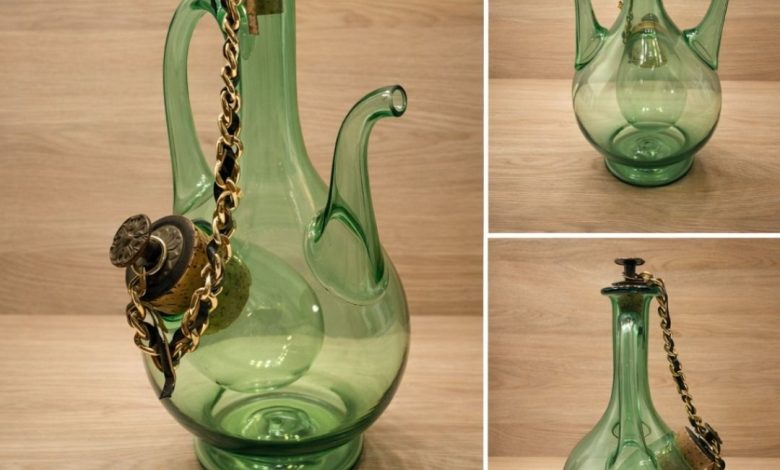
Found In A House I Moved Into. Strange double-chamber glass pitcher. The Chain Has Two Corks Attached On Either End. What is it for?
What It Is Called
This piece is best described as a vintage Italian hand-blown green glass decanter / carafe with a built-in ice chamber—often marketed as an “ice decanter,” “wine chiller decanter,” or Mid-Century Modern bar decanter.
Key identifying feature: the inner glass reservoir (“ice core”) visible inside the main body, designed to chill the liquid without watering it down.
When It Appeared
- Most commonly associated with the 1960s (Mid-Century era), when home entertaining and bar-cart culture drove demand for eye-catching, functional glassware.
- Its styling aligns with Mid-Century Modern design, emphasizing clean curves, sculptural silhouettes, and practical innovation.
Who Made It (Origin & Makers)
- These decanters were typically hand-blown by Italian glass artisans, often in workshops producing decorative and functional barware for export.
- Many examples are unmarked, meaning the exact studio or maker may be unknown unless accompanied by original labels or provenance.
- Some versions are known to have been commissioned or branded for wineries and gift programs (for example, pieces marketed as Napa Valley / Beringer-style “vintage decanters”), though the glasswork itself was usually produced by specialist glassmakers rather than the winery.
Design Features Visible in the Photos
- Green transparent hand-blown glass with a bulbous body and tall neck
- A distinct internal glass chamber used to hold ice
- Ornate cork stoppers attached with decorative chain hardware to prevent loss
- A curved pouring spout and integrated handle (seen clearly in the side view), supporting controlled pouring
- A stable thick glass foot/base for tabletop use
What It Was Used For (Primary Function)
Its purpose was to serve wine or spirits while keeping the contents cool—especially useful for white wine, aperitifs, or chilled table beverages.
How the Built-In Ice Chamber Works
- Step 1: Put ice (or chilled water) into the inner chamber.
- Step 2: Pour wine or another beverage into the main outer body.
- Result: The liquid cools through contact with the cold inner reservoir—helping prevent dilution that happens when ice is added directly to the drink.
Why It Became Popular
- Entertaining trend: The 1960s favored stylish “conversation pieces” for home bars.
- Practical advantage: Chills without dilution, a major selling point for wine service.
- Visual impact: The floating inner bulb and elegant silhouette look dramatic on a bar cart or dining table.
Collectibility Today
Collectors look for examples with:
- Intact stoppers and original chain hardware
- Clear, undamaged glass with minimal chips on the spout, rim, and base
- Strong Mid-Century form and good transparency (even with light age bubbles typical of hand-blown glass)
- Any provenance, labels, or documentation linking it to a specific Italian workshop or winery program