Found on NY beach- definitely metal, maybe jewelry? Sunglasses for scale.
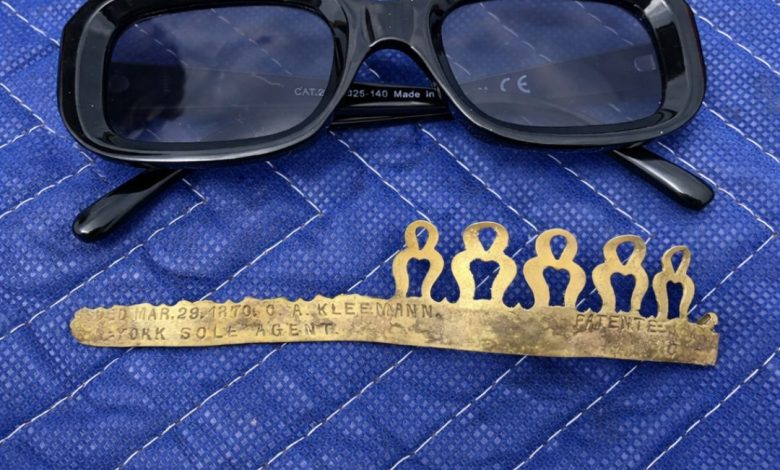
This object is a kerosene lamp in the Argand lamp tradition—an efficient 19th-century design built to provide bright, steady indoor lighting. Because it was commonly used on desks, it is often described as a reading lamp, student lamp, or study lamp. The example shown is a brass/metal desk-style lamp with multiple patent markings that place it among models sold in the 1870s.
What It’s Called
Common names you may see for this type of lamp include:
- Argand kerosene lamp
- Student lamp / study lamp / reading lamp (typical use and market name)
- Sometimes associated with the “German Student Lamp Co.” (distribution/branding context)

When It Was Made
- Museum date range: 1870–1900
- Key patent dating clue: markings referencing “PATENTED MAR. 10, 1863” and “REISSUED MAR 29, 1870” strongly point to models sold in the 1870s, especially when combined with other marks (such as “PATENTED DEC. 24. 72” on the air tube inside the burner).
- Practical takeaway: this lamp’s design features are most consistent with late 19th-century production, with strong evidence for 1870s-era variants.
Who Made and Distributed It
- Manufacturer: Carl A. Kleemann (Germany)
- Sole agent / distributor named on the lamp: C. F. A. Hinrichs, New York (marked as “SOLE AGENT”)
- Narrative context: the model is described as being imported into the USA and distributed in New York, tied to the German Student Lamp Co.
What the Patent Marks Mean (In Plain English)
Patent marks on antique lamps often identify specific mechanical improvements rather than the entire concept of a lamp. On this piece, the markings indicate a chain of design claims and reissues:
- Original patent: March 10, 1863
- Reissued patent: March 29, 1870
- Additional patent marking: Dec. 24, 1872 (noted on the air tube inside the burner)
These help collectors and historians date the style and link it to particular makers and improvement features.

Primary Purpose and How It Was Used
This lamp was designed to be a desk lamp providing focused, readable illumination. Typical uses included:
- Studying and reading at a desk or table
- Work surfaces needing a concentrated pool of light
- Indoor lighting before widespread household electrification
How It Works (Step-by-Step)
An Argand-style kerosene lamp improves brightness by controlling airflow and flame shape. In simple terms:
- Fuel storage: Kerosene sits in a cylindrical side reservoir (the container can lift out of an outer cylinder).
- Fuel delivery: Fuel moves through tubing toward the burner.
- Wick control: A mechanism raises/lowers the wick to adjust flame size (the narrative notes patented modifications to the wick-raising mechanism).
- Airflow and flame: The Argand approach promotes a stronger, cleaner burn by supporting airflow around the flame.
- Chimney effect: The tall glass chimney helps stabilize the flame and improves draft, producing steadier light.
Key Identifying Features in the Photos
- Brass/metal construction with a center vertical rod
- Round base for stability and a top ring handle
- Side cylindrical reservoir for kerosene
- Burner assembly on the opposite side with a glass chimney
- Chimney holder/crown with prominent patent lettering, including:
- “PATENTED MAR. 10 1863”
- “REISSUED MAR 29 1870”
- “C. A. KLEEMANN”
- “C. F. A. HINRICHS NEW YORK SOLE AGENT”
Why Kerosene Mattered
Kerosene became widely popular in the second half of the 19th century because it was valued as:
- Brighter than many earlier oils
- Cleaner-burning (less smoke/odor when used properly)
- More affordable and practical for many households than older lighting options
At-a-Glance Facts
- Object type: Kerosene lamp (Argand-style desk lamp)
- Likely common use name: Student / study / reading lamp
- Date range: 1870–1900 (with strong 1870s indicators from patent marks)
- Materials: Metal (brass components) with glass chimney
- Patent references: Mar 10, 1863; Reissued Mar 29, 1870; additional marking Dec 24, 1872
- Maker: Carl A. Kleemann
- Distributor/sole agent named: C. F. A. Hinrichs, New York