Margaret Cho’s Response to Lindsey Graham’s Death Reveals a Troubling Breakdown in Political Decency
The death of a political leader inevitably brings complicated reactions. Public officials make consequential decisions, attract passionate supporters and create determined opponents. Yet there should remain a basic distinction between criticizing someone’s record and celebrating that person’s death.
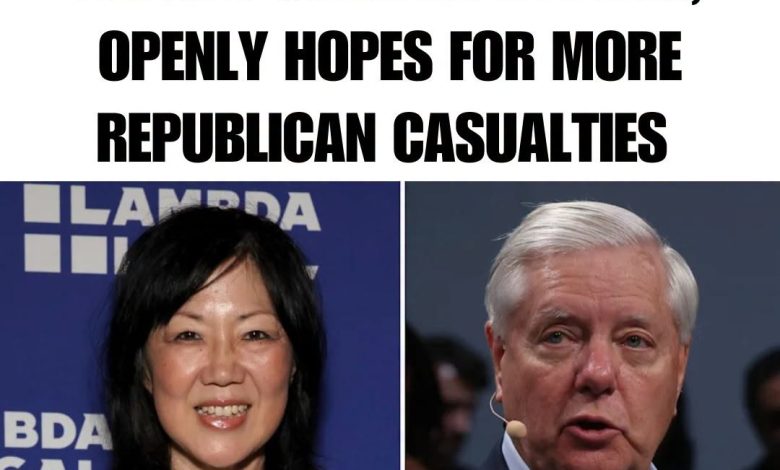
Comedian Margaret Cho appeared to erase that distinction following the death of Sen. Lindsey Graham of South Carolina, who died on July 11, 2026, at the age of 71 after a sudden heart-related medical emergency. Graham’s office confirmed his passing, while preliminary findings attributed his death to an aortic dissection associated with cardiovascular disease.
Shortly after the announcement, Cho posted a social-media video mocking the late senator. She repeatedly said goodbye to Graham, made a disparaging reference to long-running speculation about his private life and then brought up Sen. Mitch McConnell, who had been experiencing serious health problems.
Cho invoked the saying that deaths sometimes occur in groups of three and concluded with the word “Hope.” Her post was captioned “Bye gurl” and included an anti-Trump hashtag. The remarks quickly generated criticism from conservatives and others who believed she had gone far beyond political satire.
This Was Not Meaningful Political Criticism
Graham’s record was entirely open to debate.
During more than two decades in the Senate, he became one of Washington’s most recognizable advocates for a strong American military, continued assistance to Israel and Ukraine, tougher pressure on Iran and additional sanctions against Russia. He was also a prominent defender of President Donald Trump after having sharply criticized Trump during the 2016 Republican presidential campaign.
Americans could reasonably support or oppose any part of that record. They could challenge Graham’s foreign-policy positions, his Senate votes, his relationships with presidential administrations or his changing attitude toward Trump.
Cho’s video, however, offered no substantive criticism of those issues. It attacked Graham personally after he could no longer respond and appeared to express hope that another political figure would soon die.
That is not courageous satire. It is cruelty presented as entertainment.
Mocking Someone’s Private Life Crosses Another Line
Cho’s reference to Graham’s alleged sexuality was also inappropriate. Graham never publicly identified himself in the manner suggested by the comedian, and rumors about a person’s private life should not be treated as established fact merely because they have circulated online.
Disagreement over Graham’s political positions does not justify using unverified personal speculation as a weapon—especially immediately following his death.
Americans should be able to oppose a politician without trying to humiliate him personally. When public commentary abandons that principle, political debate becomes less about ideas and more about destroying the perceived enemy.
The Problem Is Larger Than One Comedian
Cho has the right to express contempt for Graham’s politics. Freedom of speech protects offensive and unpopular expression as well as respectful commentary.
But legal freedom does not eliminate moral responsibility.
A culture in which public figures receive applause for joking about death creates incentives for increasingly vicious rhetoric. It teaches audiences that compassion is owed only to members of their own political tribe and that opponents deserve humiliation rather than argument.
That attitude is corrosive regardless of which party practices it.
Conservatives should not pretend that hateful rhetoric exists exclusively on the left. Republican politicians, commentators and online activists have also made dehumanizing statements about their opponents. Selective outrage weakens the argument for civility.
The proper standard must apply consistently: Political disagreements do not justify celebrating illness, violence or death.
Graham’s Service Deserves an Honest Assessment
Graham served in the U.S. House before entering the Senate in 2003. A former Air Force attorney who ultimately reached the rank of colonel in the reserve, he became deeply involved in national-security, judicial and foreign-policy debates.
His career contained contradictions, political reversals and controversial decisions. Those issues will remain part of any serious assessment of his legacy.
But his death also left a grieving family, staff members, friends and constituents. The Senate subsequently passed a bipartisan resolution honoring his life and public service.
Recognizing that humanity does not require anyone to endorse his politics.
America Must Reject Death-Wish Politics
The United States is already struggling with intense polarization. Americans increasingly encounter one another not as neighbors with different beliefs, but as members of hostile camps.
Cho’s video contributes to that deterioration. It replaces argument with mockery and disagreement with a suggestion of death. It may attract attention online, but it does nothing to persuade voters, improve policy or strengthen the country.
America needs vigorous political debate. It does not need public figures treating the deaths of their opponents as punchlines.
Lindsey Graham’s record should be examined honestly—its achievements, failures and contradictions included. Margaret Cho’s remarks should also be judged honestly.
They were not insightful, brave or constructive.
They were needlessly cruel, and Americans across the political spectrum should be willing to say so.