OPINION: Jeffries’ Attack on Trump’s Fitness Exposes a Democratic Credibility Problem
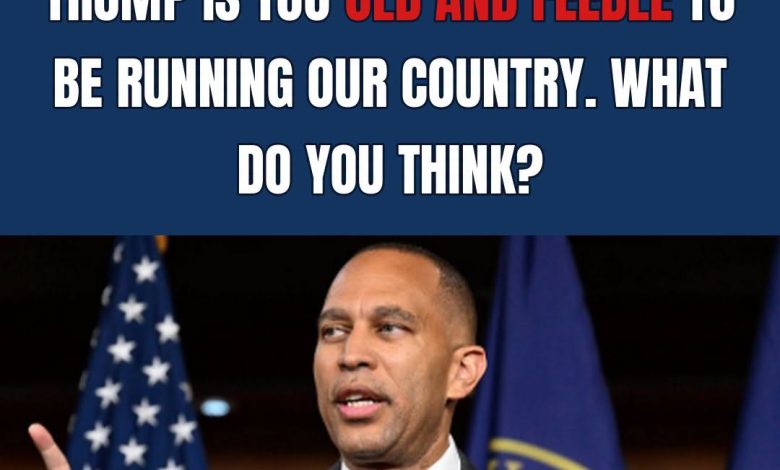
House Democratic Leader Hakeem Jeffries has repeatedly questioned President Donald Trump’s mental fitness, arguing that Trump should face the same scrutiny once directed at former President Joe Biden. In April 2026, Jeffries even suggested that Trump needed a “wellness check” following an inflammatory social-media post.
Political leaders have every right to question whether a president is physically and mentally capable of performing the job. But that standard must be applied consistently—not conveniently.
That is where Jeffries and many other Democratic officials face a serious credibility problem.
For years, Americans raised concerns about Biden’s public appearances, verbal mistakes and visible moments of confusion. Democratic leaders often dismissed those concerns as partisan attacks, misleading video editing or age-based discrimination. Only after the political consequences became impossible to ignore did many within the party acknowledge the seriousness of the issue.
Now, some of those same political voices are presenting presidential fitness as an urgent national concern because the person occupying the White House is Donald Trump.
That reversal looks less like principle and more like partisan convenience.
Age alone should never determine whether someone is qualified to serve as president. Americans should evaluate a leader by examining judgment, decision-making, transparency, communication, policy results and the ability to meet the relentless demands of the office.
Trump’s supporters see a president who continues to deliver lengthy speeches, participate in unscripted exchanges, dominate political news and maintain an aggressive public schedule. His critics see impulsive statements, personal attacks and behavior that they believe raises legitimate questions about temperament.
Both sides are entitled to make their case. But neither party should be permitted to invent one standard for its own leader and another for its opponent.
If cognitive transparency matters under Trump, it should also have mattered under Biden. If verbal mistakes are evidence of incapacity today, Democrats cannot pretend they were meaningless yesterday.
Jeffries’ argument is weakened further by the fact that Trump’s political durability is difficult to deny. He survived two impeachments, numerous legal battles, intense media scrutiny and multiple threats against his life while remaining the central figure in the Republican Party.
That endurance does not automatically prove that every Trump policy is wise or that every concern about his conduct is illegitimate. It does, however, challenge the simplistic portrayal of him as a passive or disengaged political figure incapable of directing an administration.
The more persuasive debate concerns performance rather than personality.
Supporters point to Trump’s emphasis on border enforcement, domestic energy production, lower taxes, deregulation and an “America First” approach to trade and foreign policy. Opponents challenge the economic consequences, legal foundations and long-term effects of those policies.
Those are substantive disagreements that voters can evaluate.
Reducing the argument to age allows both parties to avoid harder questions: Are families financially better off? Is the border more secure? Is the country safer? Are American institutions being strengthened or weakened? Does the president have a coherent strategy for dealing with Congress, foreign governments and economic pressure?
The presidency should be judged by measurable leadership, not selectively edited clips or partisan medical speculation.
There is also an uncomfortable lesson here for Republicans. They should not dismiss every question about Trump’s fitness merely because Democrats mishandled concerns about Biden. The correct response to Democratic inconsistency is not Republican denial. It is a demand for one transparent standard that applies to every president, regardless of party.
Presidents should provide credible medical information. They should answer questions directly. Their administrations should not conceal material concerns about their ability to govern. Members of Congress and the press should investigate genuine evidence without turning ordinary mistakes into manufactured scandals.
Jeffries is free to criticize Trump’s judgment, behavior and policies. But after Democratic leaders spent years resisting similar scrutiny of Biden, they cannot expect Americans to accept their new concern without skepticism.
The issue is not whether Donald Trump is old. The issue is whether he can perform the job—and whether political leaders are willing to judge every president by the same standard.
Voters do not need Hakeem Jeffries, Republican officials or media commentators to make that decision for them. They can examine Trump’s conduct, policies and results and reach their own conclusions.
Consistency, transparency and performance should determine presidential fitness—not partisan loyalty.